
1,000+ Floors Installed & Restored Across Washington
Tile installation · Lynnwood, Washington
Searching for tile installation near me in Lynnwood? When a buyer's inspector walks into a Lynnwood bathroom, the tiled shower is the first thing probed — and grout was never what kept the water out. The membrane below does that work. We construct that unseen layer first, hold a 24-hour flood test, keep photographic proof, and set tile only afterward. The shower in your 70s rambler ends up outliving its listing photos.
S. Snohomish floors since 2013
Family owned · Bellevue based · 12 years
Book in about a minute
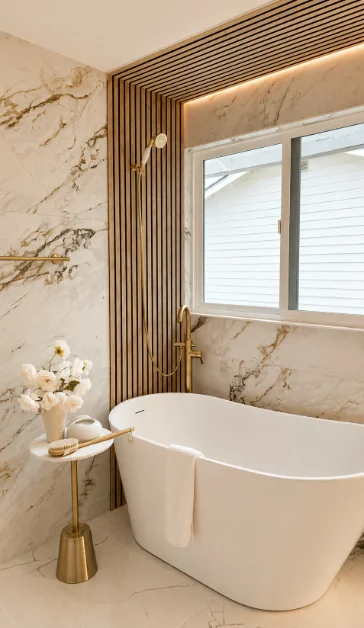
The honest Lynnwood spread is $14–$26 a square foot, installed — counting the tile itself, substrate prep, setting materials and labor, where labor's own floor is $11/sq ft. A typical tub-shower surround opens around $3,200 and peaks near $6,800; a whole bathroom — niche, shower, floor — mostly bills in the $6,500–$14,000 range, and roughly 45 sq ft of bathroom floor on its own runs $900–$1,600.
Here's what surprises sellers pricing a pre-listing remodel: the shape of the tile moves your total more than the price sticker does. Installing a $4 mosaic can outcost a $12 large-format porcelain plank, since labor is billed in cuts and grout lines rather than in what the tile cost you.
Numbers hold for Lynnwood as of August 2026 and bundle tile with materials and labor. What you should actually plan around is the written quote from the free visit.
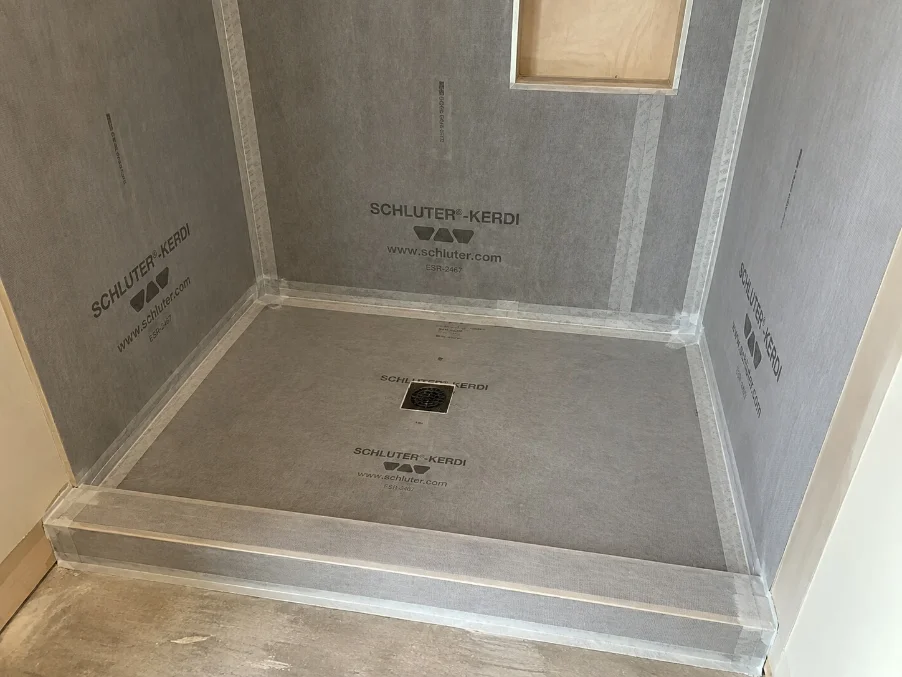
Bottom to top, seven layers. When a Lynnwood shower fails and we open it up, one of those layers was skipped — nearly always the membrane, saved a few hundred dollars at build time, and the repair now runs five figures.
The quiet failure is the expensive one. Grout admits a little water, the substrate holds it, and two years later — usually just as the house heads to market — a soft hallway floor or a stained ceiling gives it away. Fixing it then means drywall and subfloor, framing, and tiling the whole shower over.
The waterproofing layer is roughly 10% of what a shower costs. Cutting it is the priciest shortcut a bathroom remodel can take.
Every price here is a starting point; substrate condition, layout complexity and tile format each move it. The number that holds is written at your door — free.
Waterproofing built complete — sloped base, bonded membrane, a 24-hour flood test — and only then niche, entryway (curb or none) and tile. The layer no buyer sees is the one you're paying for.
Baths, kitchens, laundry rooms, entries, basements. Flattening the subfloor comes first, and where radiant heat or seasonal movement is in play we add an uncoupling membrane.
Herringbone, subway, mosaic sheet or slab-look porcelain. Clean outlet cuts, finished edge trim, grout chosen against your counter rather than off the tile box.
Radiant warmth from an electric mat under tile: uncoupling membrane below, resistance tests on either side of setting, dedicated wiring. Add it during the remodel or skip it — retrofits don't pencil.
Grout crumbling, corners letting go, tiles that sound hollow. Expect a plain verdict: fixable, or substrate already lost.
Old tile, thinset and backer stripped out behind sheeting and negative air, then hauled away the same day. Your driveway stays clear.
Rambler after Lynnwood rambler, the tile regrets we meet trace back to room choice, not tile quality. Consider this the two-minute version of the conversation we'd have in your bathroom.
Material-only pricing, before install. We bring samples along and point out where each one actually earns its cost.
Tile cost calculator for Lynnwood
Scope, square footage, format, prep — the same arithmetic our estimator runs at your door. Not a quote, but close enough to budget a pre-sale remodel.
Four to six working days covers most Lynnwood bathrooms. Mid-week sits the quiet pair — membrane day and flood-test day — that decide how long it all lasts.
“They placed plastic sheeting over the cabinets to contain the dust, so we noticed hardly any. The floors look as good or better than new.”
“We chose them because they were professional and top-notch. The work was smooth, fast and cost-effective — such skill and precision!”
“The installers were great! The floor is exactly what we wanted. We worked with OC Flooring previously — highly recommend.”
Not here? Call us at (425) 595-1079 — you'll get an installer on the phone, not a call center.
Installed, Lynnwood tile work spans $14 up to $26 per square foot — labor and tile together with setting materials and substrate prep — while the labor component starts from $11 per square foot. For a standard tub-shower surround, book $3,200 to $6,800; complete bathrooms holding floor, shower and niche mostly finish from $6,500 to $14,000. Labor tracks format, not price tag — a plain 12×12 sets far faster than either mosaic sheets or large-format.
A standard alcove shower around Lynnwood bills between $3,200 and $6,800, with demolition, bonded waterproofing, the pre-sloped pan, tile work, niche and grout all inside the figure. Above that sit benches, curbless entries, steam and full-height stone. Roughly one tenth of the total is waterproofing — cheap insurance against the failure that reaches five figures.
Yes, every single time. We never tile over bare cement board and thinset; a bonded waterproofing system sits behind each shower. Its parts: pre-sloped base, membrane climbing the walls, every seam, corner and pipe penetration sealed tight, plus a photo-documented 24-hour flood test ahead of any tile. Grout and tile do no more than shed water; keeping it off the framing falls to the membrane alone.
Typical Lynnwood bathrooms run four to six working days. The order: demolition behind dust protection, then substrate and waterproofing, the 24-hour flood test capping that stage, then setting across a day or two, and to finish — grout, silicone, trim. First use of the shower waits one more day — 24 hours of cure. Standalone floors finish in about one to two days.
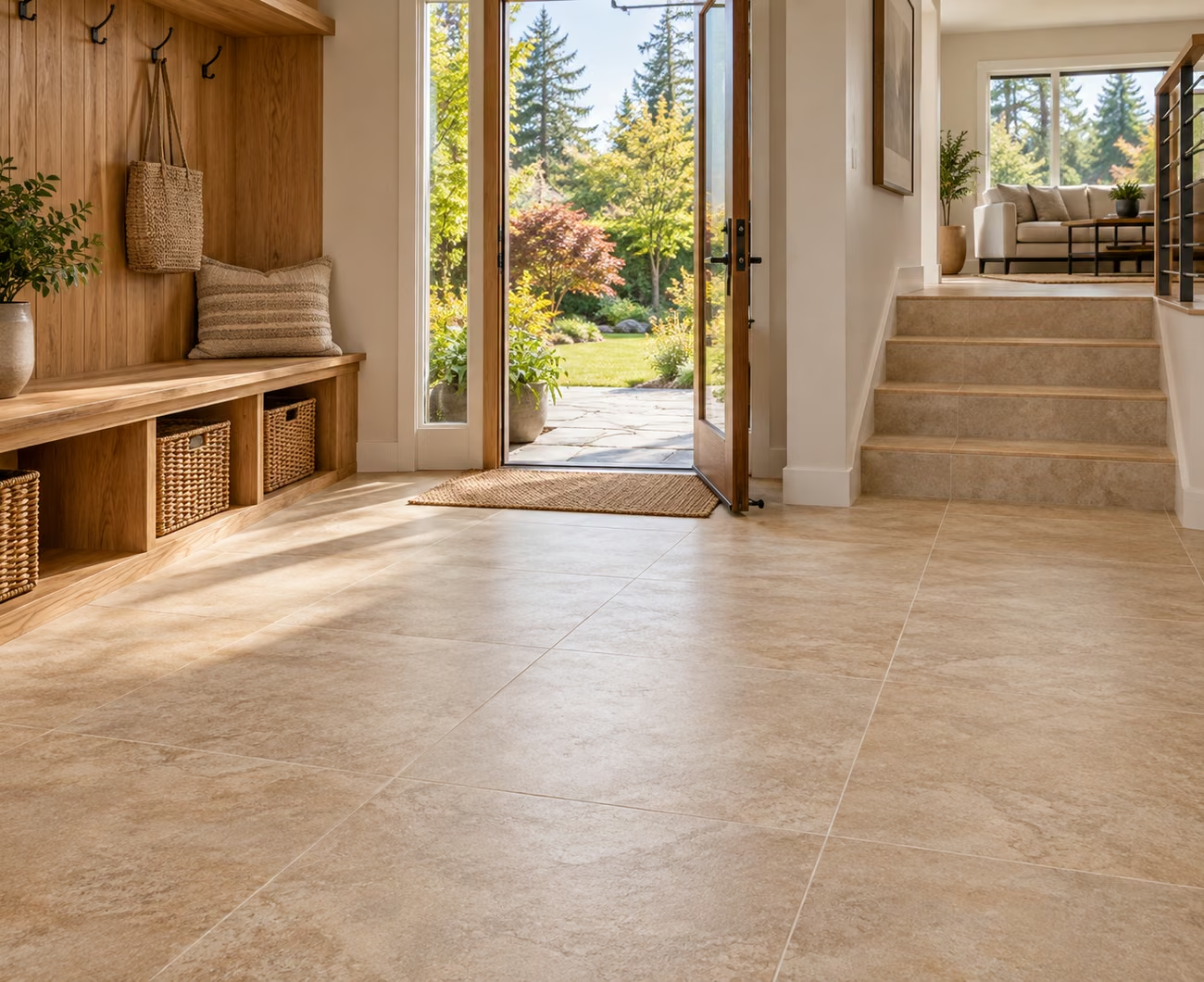
Where things get wet or worked hard — floors, showers — porcelain wins on density, sub-0.5% water absorption and chip resistance. Walls and backsplashes are ceramic territory: cheaper, and up to the job. Around Lynnwood our spec puts porcelain under every foot and in every shower floor, with ceramic or glass free to shine on the vertical.
We can — and it's a line listing agents love in a description. Electric radiant under tile prices out near $11 to $16 for each installed square foot, thermostat in that number; the arithmetic holds only while the floor is up anyway. Underneath goes an uncoupling membrane, resistance is verified either side of setting, and the mat gets a dedicated circuit.
Usually the old tile comes out. At about $3.50 per square foot for demo with haul-away, you buy the one clear look at your subfloor — rot, movement — and the chance to land finished height right where doorways need it. A flat, sound, well-bonded old floor can sometimes be tiled over, but doing so lifts the finish level and hides faults that demolition would have surfaced before grout locked everything in.
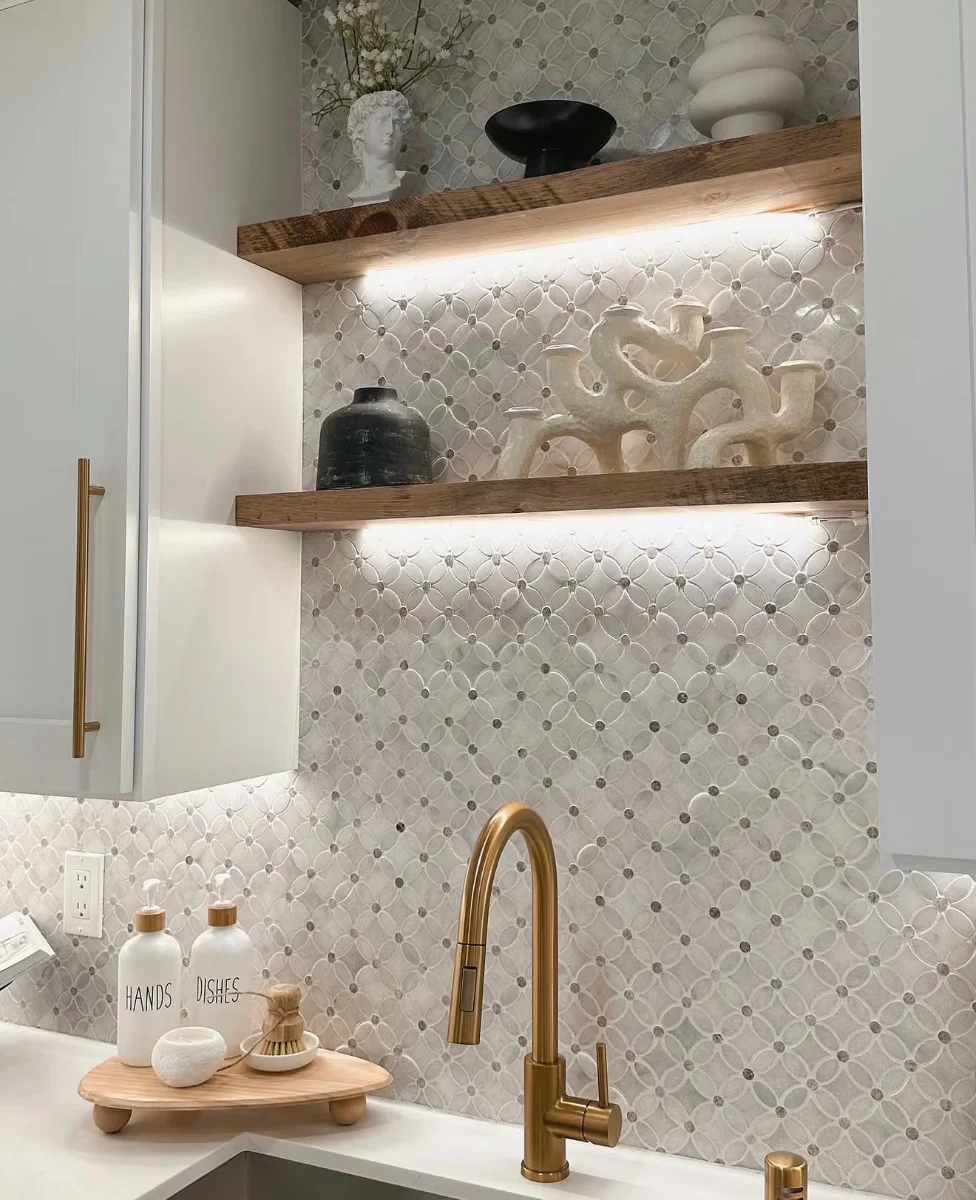
Around $1,100 to $2,200 installed covers the typical 30 square foot Lynnwood backsplash — outlet cuts, trimmed edges and grout matched to the counter are part of it. What pushes toward the ceiling of that range is cutting time: herringbone, mosaic sheets, framed details over the range, slab-look porcelain taken full height. The material itself is rarely the reason.
Yes, often. Repair and regrout, from a starting rate of $8 per square foot, make sense when grout has stained or crumbled, when a couple of tiles cracked under impact, or when corners want silicone swapped in for grout. The line gets drawn at failed substrate — hollow-sounding tile, loosening in a pattern, walls with give — where a patch buys only months. Which side of that line you're on, we tell you before any quote.
All of Lynnwood — Alderwood Manor, City Center, South Lynnwood, Scriber Lake, Cedar Valley, College Place, Meadowdale, Perrinville, Martha Lake, Lake Serene, Swamp Creek and Picnic Point — along with Mountlake Terrace, Brier, Edmonds, Mill Creek and the rest of south Snohomish County down to north Seattle.
Our tile installs come with a 2-year workmanship warranty from OC Flooring — carpet gets less, because tile faults make themselves known in year two, not week two. If your shower uses one manufacturer's complete bonded assembly, their coverage adds another layer, and the membrane and flood-test photos join your records — useful paperwork at sale time.