1,000+ Floors Installed & Restored Across Washington
Searching for floor repair near me in Shoreline? We repair cracked hardwood, stained boards, swollen laminate, and separated vinyl plank without replacing the whole floor. Call (425) 595-1079 for a free estimate.




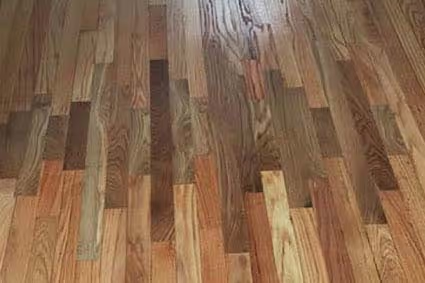
This is what we are hired to avoid. New boards dropped in without matching species or grain direction. It never blends in later; it just stays the first thing you notice.
Both of those floors came off a production line, which ought to make matching easy and does not. The oak in the ramblers and split-levels was milled to standard widths and grades, so the board itself can usually be bought and the work moves straight to color. The plank going down near the stations has to be identified first, by manufacturer, line and color, and when that line has been discontinued the closest match becomes a decision rather than an order.
Shoreline's postwar floors are mostly narrow red oak strip, and it comes out one board at a time — cracked, split, cupped or stained pieces cut free and replaced with oak matched for width, grain and color. Gaps that stay open right through the wet season get shimmed with oak strips instead of packed with putty, so the fix still reads as floor a year later.
Two kinds of damage show up on the same floor here: dog claws, chair legs and grit walked in off the driveway, and the ring of tack-strip nail holes and staples left around every room when the carpet finally came up. Shallow marks are buffed and recoated, deeper gouges are filled and blended, and perimeter boards too chewed up to save get swapped out.
Urine and standing water pass through the finish into the grain, which is why mopping has never touched them. We probe the boards and take a moisture reading underneath before quoting, let anything still damp dry out, then cut the ruined pieces free and blend new wood into the color around them.
Lifting planks, cracked wear layers, curled ends and seams that have opened up — the standard list in Shoreline's newer townhomes and in rentals between tenants. We work out what made the floor move first, whether that is afternoon sun through west-facing glass, a floating floor pinned by trim, or a low spot underneath, then replace the damaged planks and close the seams.
Laminate carries a printed layer that cannot be sanded, so swollen edges and chipped corners mean replacing planks rather than refinishing them — we unlock the run, change what is damaged and lock it back down. Split-levels bring a lot of doorway strips and landing nosings with them, and those get re-cut or replaced so they sit flat and hold the plank edges down.
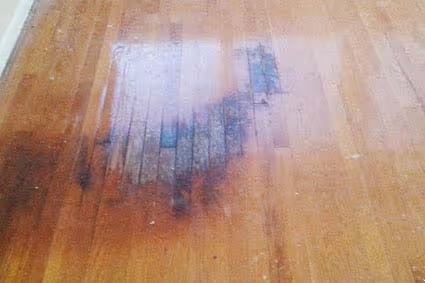
Most of the stains we get called out for in Shoreline were made years before anyone saw them. Carpet and pad hold a spill against the oak instead of letting it dry off, so the mark is already old and set by the time the carpet comes out and somebody finally looks at the floor. Where the finish had worn through before the carpet ever went down, along a traffic line or in front of a sink, there was nothing slowing that spill in the first place.
 1
1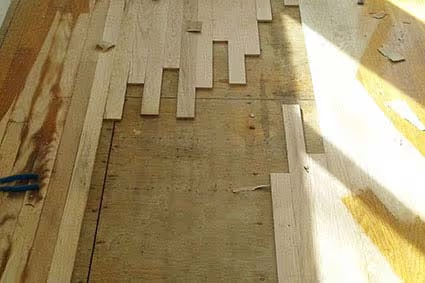 2
2 3
3 4
4Most pet-stain and water-damage repairs are finished in 1–2 days.
Order matters here more than people expect. If the room is getting sanded anyway a replacement board can be a shade off and still disappear under the new stain, and if it is not, that board has to be finished to match a floor that has already aged around it. Oak worn along the traffic lines and nowhere else is usually a recoat and a handful of boards rather than a full sand, while laminate and vinyl plank have no sanding to weigh at all and come down to a count of damaged planks.
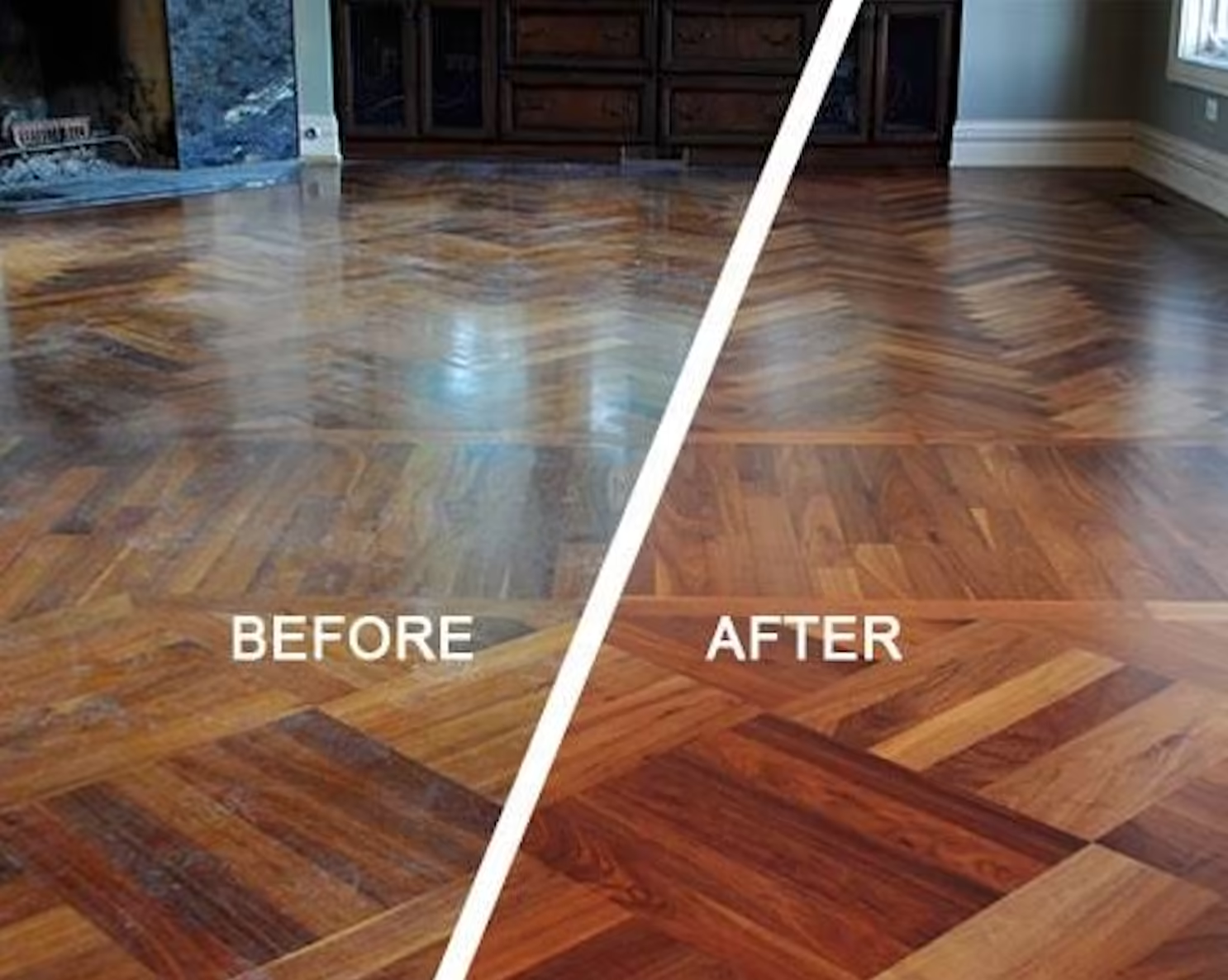
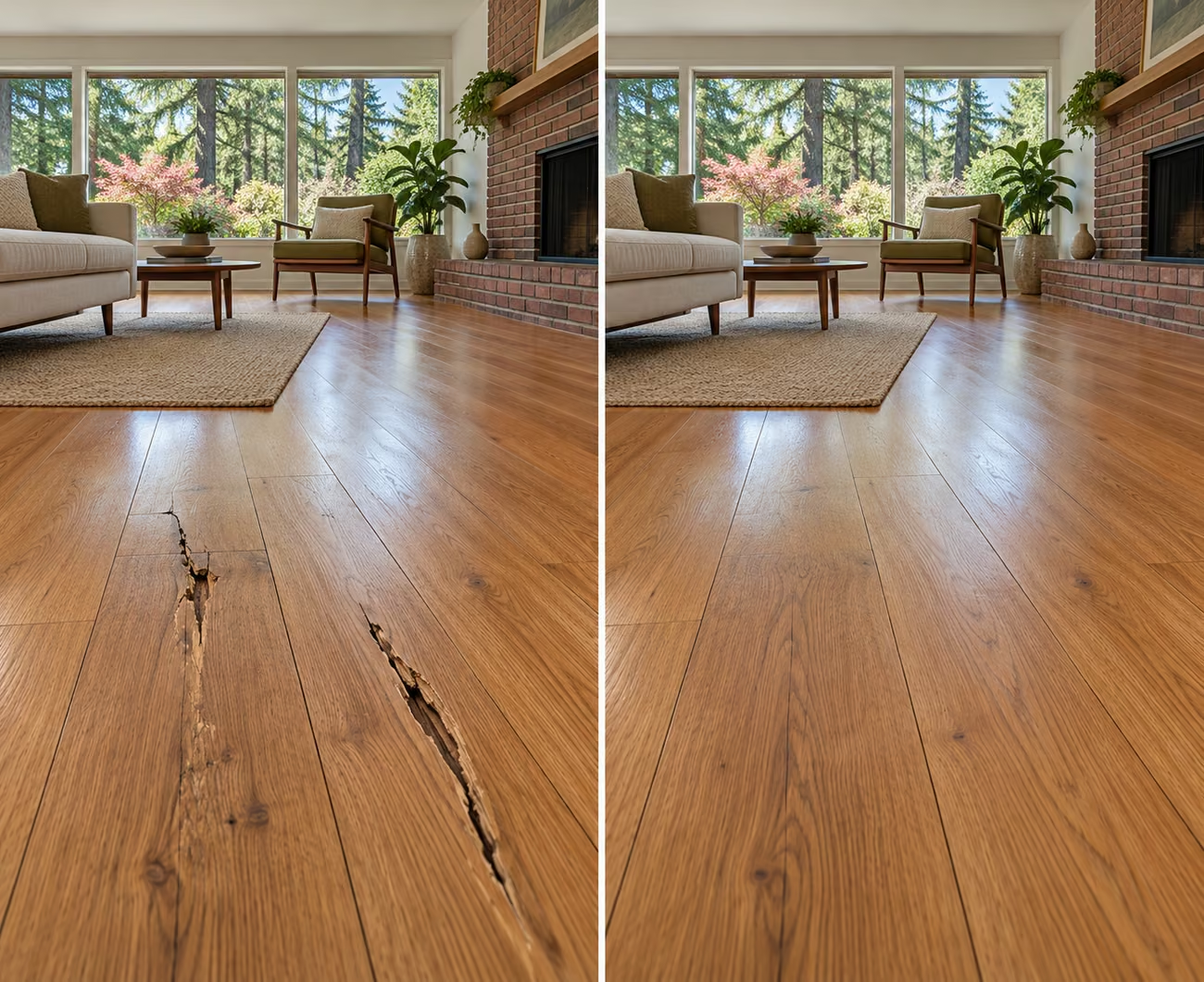
The same floor, split down the middle. Left: the finish is cloudy and worn through in the traffic path — no amount of patching fixes that. Right: sanded back and refinished.
Typically $200–$1,000 · most finished in 1–2 days
Board replacement is done first, so the whole floor is finished together
The bead test. Drip a little water onto the tired-looking area. Beading means the coating is intact and a spot repair will hold. If it darkens and soaks in, the finish has worn through and the room wants refinishing.
The furniture test. Slide a rug or a side table aside. A clear color step between the covered wood and the exposed wood is sun fade, and replacing individual boards there only adds a third shade.
Still not sure? Send us a few photos of the floor and we will tell you which one you need, even when it is the cheaper answer.
Cross N 145th Street out of Seattle and the wood under your feet changes. Seattle pushed its limits north to that line in 1954, and everything south of it in the north end is largely pre-war housing built over vertical-grain old-growth Douglas fir. Shoreline is the postwar half. Between 1950 and 1957 it was the fastest-growing area in the Seattle metropolitan region, adding 64 percent to its population, and most of what went up in that stretch was ramblers and split-levels laid over narrow red oak strip. Oak is harder than fir and shrugs off furniture legs better, but almost none of these floors have had an easy life.
Wall-to-wall synthetic carpet reached the mass market around 1954, right in the middle of Shoreline's build-out, so a great many of those oak floors were covered within a decade of being nailed down.
Thirty or forty years later the carpet came up again, and what turns up underneath is a specific and very repairable mess: a line of tack-strip nail holes and staples every few inches around the whole perimeter of every room, pad adhesive across the field, and — on floors a previous owner already sanded once — not much oak left above the tongue. That is why so much of our work in Ridgecrest, Briarcrest, Parkwood, Meridian Park and Hillwood is board replacement rather than sanding. Ramblers make it harder still: a single-story open plan carries the same run of floor from the entry through the living room into the hall, so a repair has nowhere to hide behind a doorway, and matching species, width, grain and sheen stops being a nicety.
The western slope down to Puget Sound is its own category. Richmond Beach was platted in 1890 and still mixes early cottages with rebuilt view homes. Innis Arden was subdivided out of William Boeing's land in the 1940s under covenants written to protect sight lines, and its five hundred-odd houses lean heavily on 1950s ranch and custom mid-century. The Highlands, laid out by the Olmsted Brothers in 1907 some 450 feet above the water, holds floors older than anything else in the city.
Those covenants exist to keep the view, which means a lot of west-facing glass, which means a bleached stripe of floor where the afternoon sun lands every single day — usually fixable by sanding and re-staining that section rather than the whole room. Hillside lots also mean daylight basements, and a finished basement floor that darkens along the outside wall is telling you the moisture is arriving from below or from the wall, not from a spill.
The other half of our Shoreline calls come from floors barely old enough to have problems. The city upzoned the ground around its two future light rail stations in 2015 and 2016 — MUR-35 and MUR-45 along 145th, 148th and 185th, up to seventy feet nearest the platforms — and by the time trains started running in 2024, thousands of new units were finished or in the pipeline. Almost all of them are LVP or thin-wear-layer engineered plank.
Those floors do not rot; they lift, gap at the seams and telegraph every low spot beneath them, and the thin wear layer rules out sanding, so the repair is a plank swap and the hard part is matching a manufactured product instead of a species. With roughly a third of Shoreline households renting, we also see a steady run of turnover work: one scratched entry, three planks by the fridge, a threshold somebody caught with a dolly. Repairing hardwood, laminate and vinyl plank floors throughout Richmond Beach, Innis Arden, The Highlands, Ridgecrest, North City, Echo Lake, Briarcrest, Parkwood, Hillwood, Meridian Park, Richmond Highlands, Highland Terrace and Ballinger.
Most of what we do lands between $200 and $1,000. The number moves on how many boards have to come out, whether we can buy matching oak off the shelf or have to hunt down salvage or a discontinued plank, and whether the repaired area needs sanding and finishing to blend with what surrounds it. Water that got underneath adds time, because the area has to dry before anything new goes down. You get a written price at the visit, not a guess over the phone.
Usually yes, and it is one of the most common calls we take in Shoreline. Tack-strip holes, staples and pad glue all clean up. The question that decides it is thickness. If the floor was already sanded once when the carpet first came out, or if you can see tongue-and-groove edges or nail heads at the surface, there may not be enough oak left to sand again — in which case the beaten-up perimeter boards get replaced instead of the whole floor being taken down. We measure before telling you either way.
It depends entirely on how deep it went. A stain sitting only in the finish will normally sand away. Once urine has soaked into the wood itself — the black, spreading marks you see in hallways and bedroom corners — sanding cannot reach it and those boards get cut out and replaced. Smell is the giveaway: if you can still smell it after cleaning, it is in the wood or in what lies below it, and we deal with both.
Yes, but only after we work out why it moved. Lifting LVP in newer construction is almost always one of three things: expansion from direct sun, a floating floor pinned in place by trim or something heavy sitting on it, or a low spot underneath that the planks bridge until they stop bridging it. Swapping planks without fixing the cause buys you a season. Once that is sorted we replace the damaged planks and close the seams back up. If the builder left you spare boxes, hang onto them — matching a current product line is easy, matching a discontinued one is not.
It is, though not the way wood is. Laminate has a printed wear layer that cannot be sanded, so swollen and chipped planks get swapped rather than refinished. If yours is a click-lock floating floor we can usually unlock the run from the nearest wall, change the bad planks and lock it back together. Landings and stair nosings often need the transition piece re-cut at the same time, since that joint is normally where the water found its way in.
On a hillside lot that is nearly always moisture arriving from below or through the wall, not something that was spilled on top. We take a reading under the boards before quoting anything, because covering wood that is still damp is how a repair comes apart the following winter. If the source is still active, that has to be handled before new flooring goes down, and we will tell you plainly when that is where you are — even though it means we do not start that week.
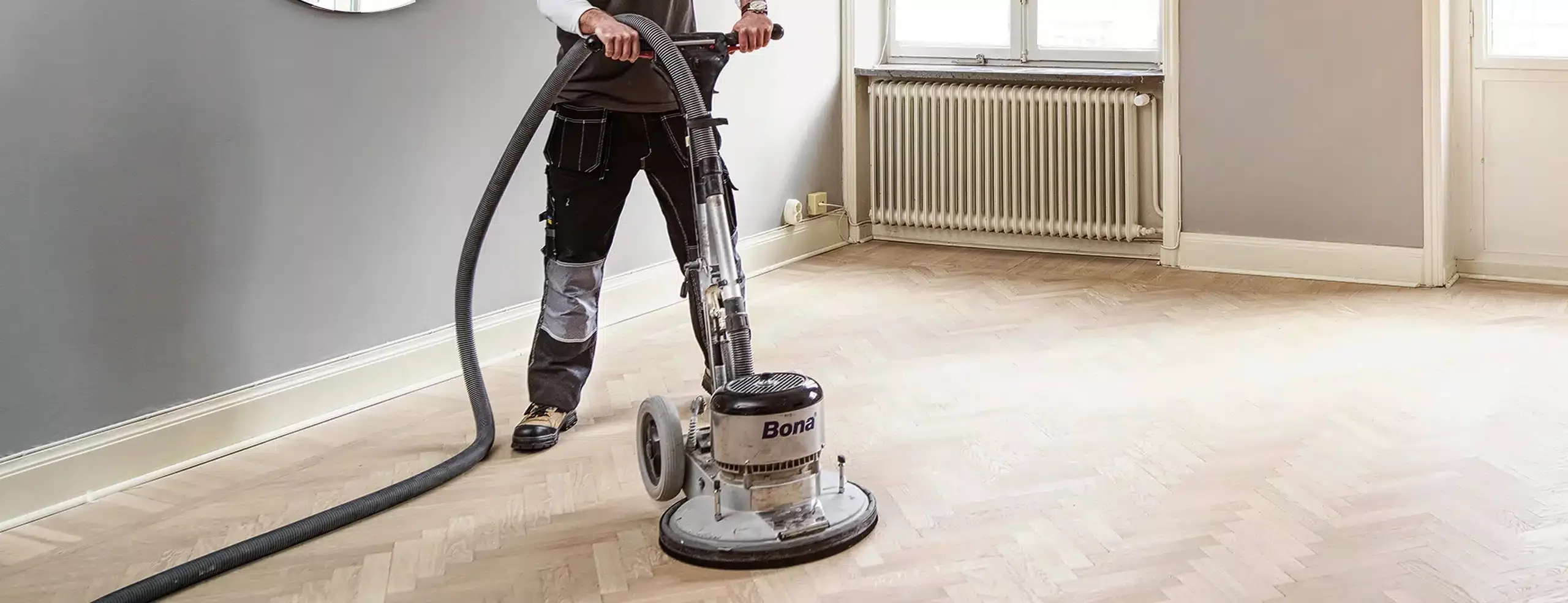
Solid wood keeps a reserve. A solid oak board carries enough thickness to sand a problem out completely — which is why deep damage in a postwar Shoreline floor is often repaired in place instead of replaced.
Solid hardwood is the one floor with margin built in. Where a plank near the 185th Street station has a wear layer measured in fractions of a millimeter, the red oak strip in a Ridgecrest rambler or a Parkwood split-level can give up a full pass of sanding and still have decades left. So before we quote a board swap, we ask whether the damage actually goes deeper than the finish — because a surprising amount of it does not.
When a floor develops a gap or a soft spot, the boards you see are rarely the ones at fault. The problem lives underneath — a fastener that has let go of its joist, a subfloor panel rubbing its neighbor, or framing that has dried and shrunk a hair since the house went up. Most of Shoreline went up in a rush between 1950 and 1957, which puts these floors at the age when fasteners start letting go. We chase the problem to its source instead of patching the symptom.
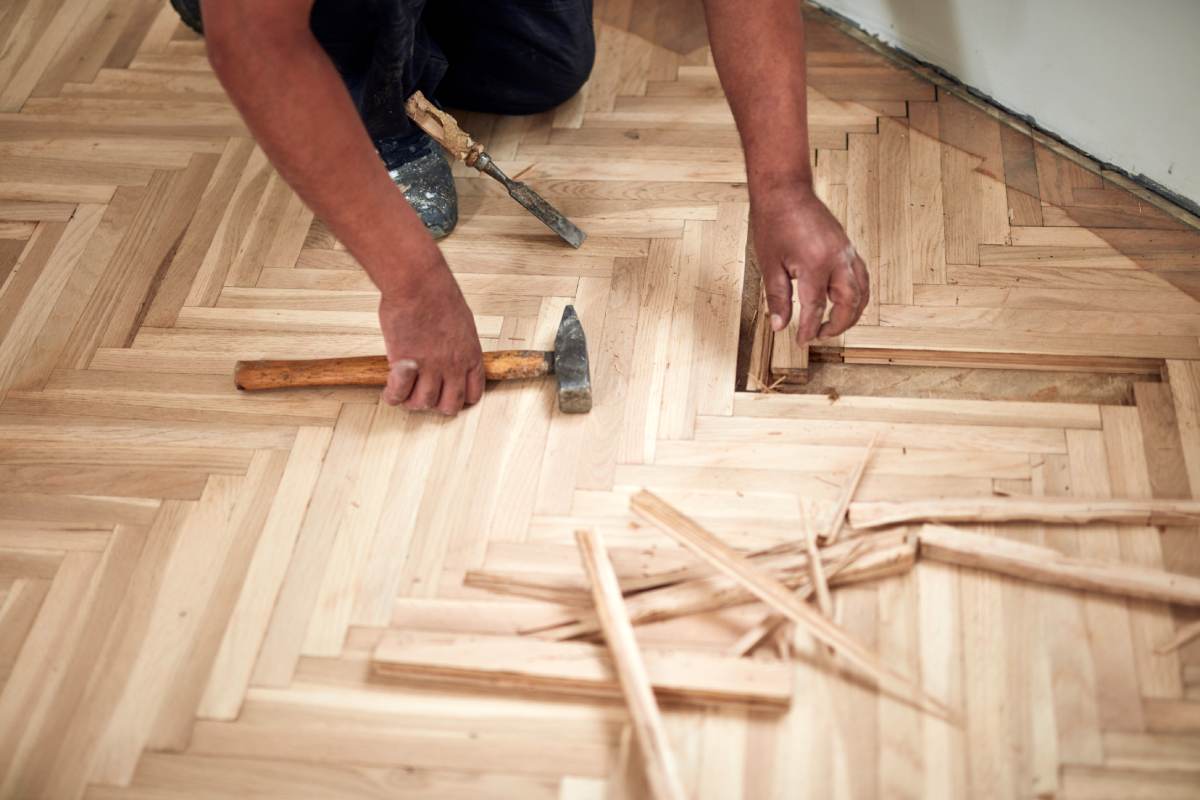
The fix starts under the boards. Loose pieces come up, the substrate gets fastened flat, and only then does the surface go back together.
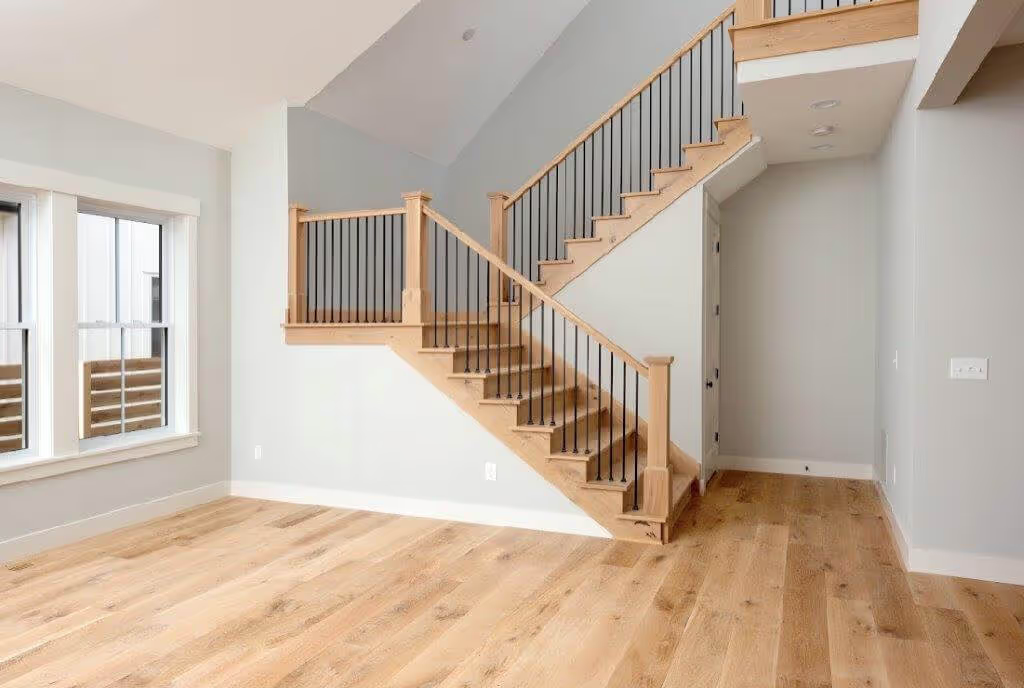
Stairs take the traffic of a hallway on a tenth of the wood. Treads, nosings and thresholds wear out years before the rooms around them — and they can be repaired one piece at a time.
Every walk down to the laundry, every school run, every dash to make the train at 185th lands on the same few square feet of wood. Shoreline is split-level country, so the busiest floor in the house is usually a short flight and a landing, and the nosing on each tread takes the full strike of every step. Add a daylight basement and you have two staircases doing that work. These are the repairs people put up with for years because they assume the whole staircase has to come apart. It does not.
Photograph the damage on your phone — a close-up of the worst spot, one from a few feet back, and one of the whole room. One of our estimators looks at every photo personally and emails you a written price the same business day. No visit, no sales call, no obligation.