1,000+ Floors Installed & Restored Across Washington
Searching for floor repair near me in Newcastle? We repair engineered hardwood and vinyl plank by replacing damaged boards, correcting lifting seams, and rebuilding worn thresholds. Call (425) 595-1079 for a free estimate.




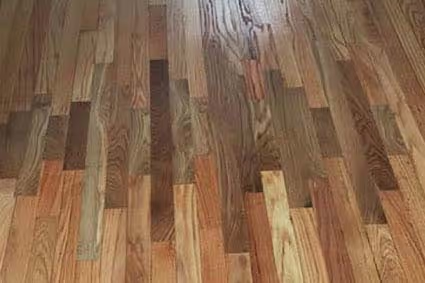
A patch that announces itself. The wood is close but not right, and the grain runs the wrong way. Matching properly is most of the skill in a board repair.
What holds a floor down in this city changes with the decade it was laid. The oak strip in the 1950s and 60s houses went down one board at a time on nails, the engineered plank that followed is often glued or floated over a pad, and the builder laminate and vinyl after that click together edge to edge and touch nothing underneath. That fastening decides the repair: a nailed board gets cut free and a new one blind-nailed into the gap, a glued plank gets scored, lifted in pieces and bedded in fresh adhesive, and a floating run gets opened from its edge and relocked. Same gouge, three different afternoons.
Engineered flooring is the default in Newcastle because it is what builders used through the 1990s, 2000s and 2010s. A real wood wear layer sits over a plywood or HDF core, and that layer is usually only two to four millimeters thick — enough for one light screen and recoat, not for a full sanding. So when a plank splits, cups after a leak, or takes a gouge that cuts past the veneer, the repair is to lift that plank out of the field and set a new one in without disturbing the runs around it. We identify the product first — width, bevel profile, core, sheen — then source a match or borrow a plank from a closet to keep the visible area clean.
Floating LVP in Newcastle lower levels almost always fails at the joints before anywhere else. On a slab, that points to moisture or a high spot the original installer skimmed over. On a framed floor it is usually expansion with nowhere to go, because an island, a bookcase or a tight bathroom transition has the floor pinned. We find the cause before touching a plank — meter on the slab, straightedge across the run, a look at the perimeter gap behind the base — relieve it, replace the damaged planks, and close the seams so the floor can move the way it was built to.
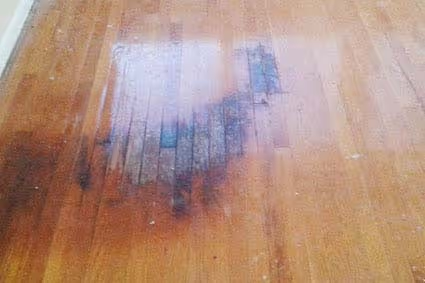
A weeping refrigerator line or a dishwasher pan that never drained shows up as a dark halo weeks after the water itself is gone. On solid oak, light darkening will sometimes sand out; once the stain reads black, or once there is an odor, the wood is saturated and the board comes out. On engineered and vinyl there is no sanding option at all, so it is a plank replacement either way. We pull the affected material, dry the area and take a moisture reading underneath, then set new boards once the number is where it belongs.
The Newport Hills-era ramblers and split-entries, and the custom houses up in the Highlands, are where true site-finished solid oak still turns up in this city. Surface scratches confined to one room can often be screened and recoated rather than fully refinished. Deeper damage — dog claws, a dropped cast-iron pan, a dining table dragged across a room — gets board replacement plus a blended finish: stain mixed to the aged color of the floor around it, then sheen matched so the patch does not flash when afternoon light comes across it.
Split-entries, daylight basements and the three-level plans in the newer Newcastle subdivisions add up to a lot of doorways, landings and stair nosings, and those are the pieces that wear through first. We replace cracked or lifted transition strips so they sit flat and hold the plank edges down, rebuild worn nosings at the top of a run, and swap swollen or chipped laminate by unlocking the run back to the damage. If a laminate decor has been discontinued, we tell you that at the estimate and talk through options instead of dropping in an obvious mismatch.
A finish is a film, not a seal, and liquid finds the same few ways under it every time: a seam, a beveled edge, or the gap at a threshold. Downstairs, where the floor sits on concrete, whatever gets under a plank has nowhere to go but sideways, so a tipped bowl or a slow leak travels along the run and surfaces two or three boards from where it started. The same accident upstairs usually flashes off in a day, which is why one spill costs a single plank on the main level and five below it.
 1
1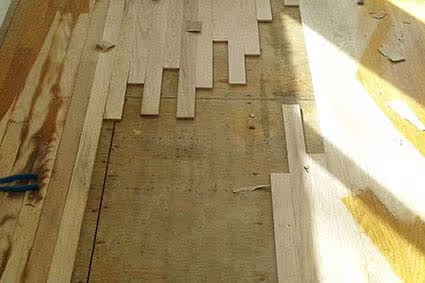 2
2 3
3 4
4Most pet-stain and water-damage repairs are finished in 1–2 days.
Refinishing means taking a floor down to bare wood and building the finish back, and only a modest share of houses here are built to take it — the oak strip in the older ramblers and split-entries, and the occasional solid floor in a custom house. Everywhere else the question is narrower: does the damage need boards out, or will a recoat carry the floor another few years. We measure the wear layer at a heat vent or a threshold where the edge of a plank is exposed, check how deep the damage actually goes, and answer that at the estimate rather than after a sander is already in the room.
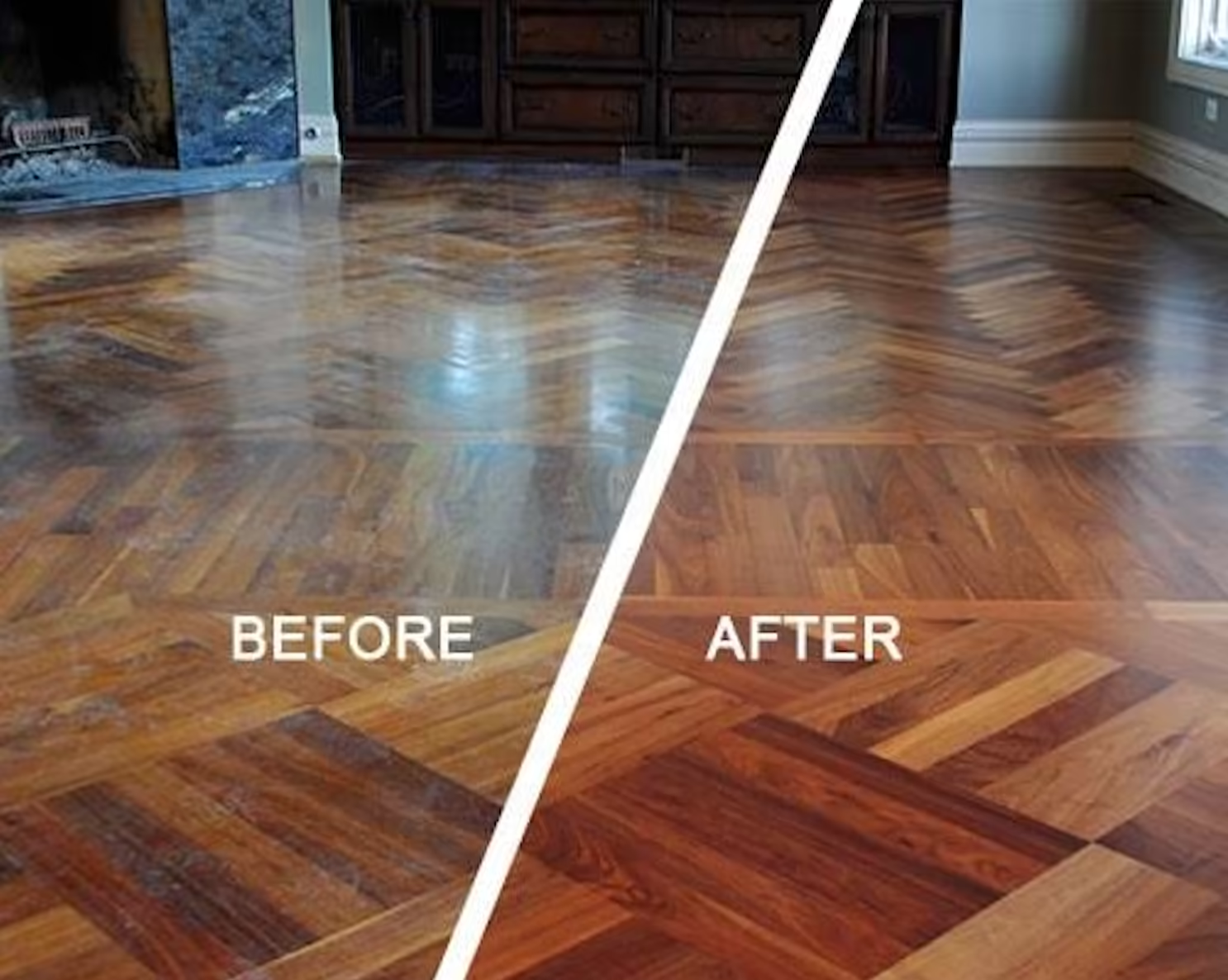
The same floor, split down the middle. Left: the finish is cloudy and worn through in the traffic path — no amount of patching fixes that. Right: sanded back and refinished.
Typically $200–$1,000 · most finished in 1–2 days
Board replacement is done first, so the whole floor is finished together
Water on the worn patch. If the drop sits up and beads, your finish still works and patching is sensible. If it sinks in and darkens the wood within a minute, that room needs sanding and refinishing, not a patch.
Look under the rug. Wood that is markedly darker beneath a rug than beside it has faded in the light. Fade runs across a whole zone, so swapping single boards there makes the mismatch worse, not better.
Still not sure? Send us a few photos of the floor and we will tell you which one you need, even when it is the cheaper answer.
Newcastle is unusual for an Eastside city: it has almost no prewar housing. The original coal town northeast of Lake Boren never incorporated and had largely vanished by the 1930s, so the vertical-grain fir and 2¼-inch strip oak you find under a Ballard bungalow is simply not the baseline here. The oldest floors we work on in this city trace to the Newport Hills development announced in April 1958 — ramblers and split-entries with daylight basements cut into the slope below Cougar Mountain. Those houses typically pair oak strip on the main level with a concrete slab downstairs, which is why the upstairs and the lower level of the same address often need two completely different repairs.
The bigger share of the city arrived much later. The median Newcastle home was built around 1999, and close to half the housing stock went up after 2000. The Highlands at Newcastle, The Trails, The Reserve, China Falls and East Olympus filled in while the golf club's Coal Creek course opened in 1999 and China Creek followed in 2001, both laid over ground that had been mined for a century. Flooring from that stretch is overwhelmingly engineered hardwood with a thin wear layer, then builder laminate, then LVP from the 2010s. None of it sands out. A gouge through a two-millimeter veneer is a plank replacement, and treating it like solid oak destroys the floor.
Attached housing is a much larger slice of Newcastle than of most neighboring cities. Coal Creek Park went up in 1990, Walker's Run in 1991, the four-story Parterra in 2001, and townhomes and duplexes followed around Newcastle Commons. Roughly four in ten households here rent, so a steady part of our work is turnover repair in units where the builder's flooring was discontinued a decade ago and the HOA has a quiet-hours window we have to schedule inside.
Water is the other constant. The city drains into three watersheds — Coal Creek, May Creek and East Lake Washington. Coal Creek drops from about 1,400 feet on Cougar Mountain and runs seven miles through steep ravines toward the lake, China Creek feeds Lake Boren, and Hazelwood Park is a boardwalk over forested wetland. Homes on those lower, wetter lots and homes with finished daylight basements get slab moisture working up under engineered and LVP long before anything is visible at the surface.
We take readings before quoting so the repair does not quietly fail six months later. One more Newcastle-only wrinkle: parts of the city sit over mapped coal-mine workings, and in the 1980s a collapsing tunnel opened a sinkhole under a house off Coal Creek Parkway. That is rare, and it is not flooring work — if a floor problem points at something structural, we say so and send you to a structural engineer rather than paper over it.
It can be repaired, and in Newcastle it is the most common job we do. Engineered flooring has a real wood wear layer over a stable core, and that layer is usually only two to four millimeters thick, so it cannot be sanded the way solid oak can. What it can do is come apart plank by plank. We cut out the damaged planks, keep the surrounding runs locked together, and set matching material back in. A leak in one corner or a gouge in a hallway does not require replacing the whole floor.
Most spot repairs land between $200 and $1,000, and most are finished in one or two days. What moves the number is how many planks come out, how hard the material is to source, and whether the repair needs finish blending afterward. Discontinued builder flooring from a 1990s or 2000s Newcastle subdivision takes real sourcing time compared with a current product, and that shows up in the price. You get a written figure at the visit before any work begins, and estimates are free.
Below-grade concrete behaves differently from a framed floor. Slabs on Newcastle's hillside lots carry moisture that migrates up through the concrete, and vapor under a floating floor works the joints apart. The other frequent cause is a high spot in the slab that the original installer skimmed over. We put a meter on the concrete and a straightedge across the run before quoting, address the cause, then swap the damaged planks. Skipping that step is exactly why the same seams reopen a year later.
Often yes, just not from a store shelf. Newcastle has a lot of attached housing from 1990, 1991 and 2001, and builder-grade flooring from those years is rarely still in production. We look for discontinued stock first, then for donor material already inside the unit — a closet floor, the area under a permanent appliance, a section hidden behind a door. If nothing blends convincingly in a room you look at every day, we tell you rather than installing a plank you will notice forever. HOA access and quiet-hours rules get built into the schedule up front.
It depends how deep it went. Surface darkening on solid oak can sometimes be sanded back and re-stained. A stain that has gone black, or one you can smell, means urine reached the wood fibers and usually the layer beneath, and sanding will not remove that — the board comes out. On engineered or vinyl plank there is no sanding option at all, so it is a plank replacement regardless. We check moisture underneath before anything gets closed back up.
Almost certainly not. King County does map coal-mine hazard areas across this part of the Eastside, and in the 1980s a collapsing tunnel opened a sinkhole under a house off Coal Creek Parkway — but that is extremely rare, and it is not what is behind a gap, a lifted plank or a cupped board. Those come from moisture, seasonal movement, or a floating floor that has been pinned by furniture or a tight transition. We will tell you which one you are looking at. If what we find genuinely points to a structural issue rather than a flooring one, we say so and refer you to a structural engineer. We do not do subfloor or framing work, and we will not patch over something that needs a different trade.
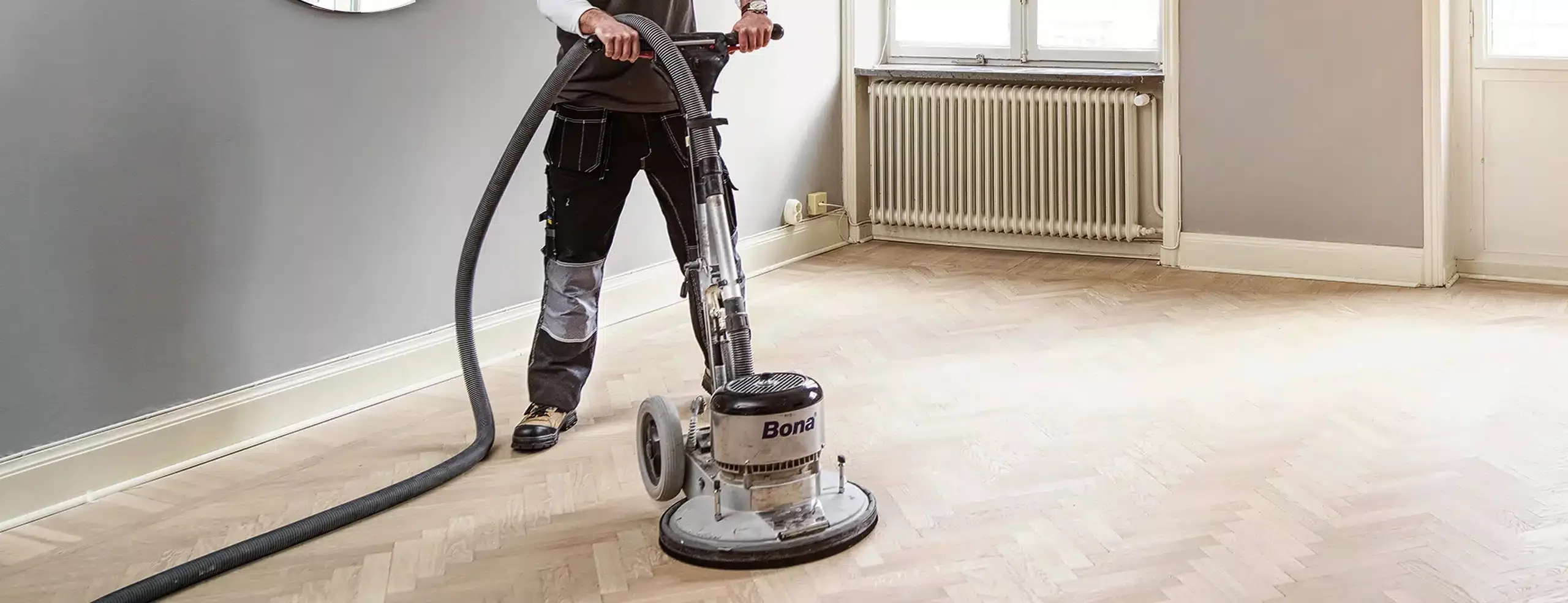
Solid wood keeps a reserve. A solid oak board carries enough thickness to sand a problem out completely — which is why deep damage in one of Newcastle's older floors is often repaired in place instead of replaced.
Most Newcastle floors are not sandable, and we say so plainly — a two-millimeter veneer has no reserve to give. But where solid wood does turn up here, the arithmetic flips completely. The Newport Hills-era ramblers and split-entries, and the custom houses up in the Highlands, still carry true site-finished oak, and a solid board can give up a full pass of sanding and still have decades left. So on those floors, before we quote a board swap, we ask whether the damage actually goes deeper than the finish — because a surprising amount of it does not.
The trouble is underneath — an unflattened high spot the original installer skimmed over, or a floating run pinned so tight it has nowhere left to move. The median Newcastle house dates to about 1999, and the Newport Hills ramblers go back to 1958, so both ends of this city are now old enough for that to start. We find the cause before anything gets opened up, and we tell you which trade the fix belongs to.
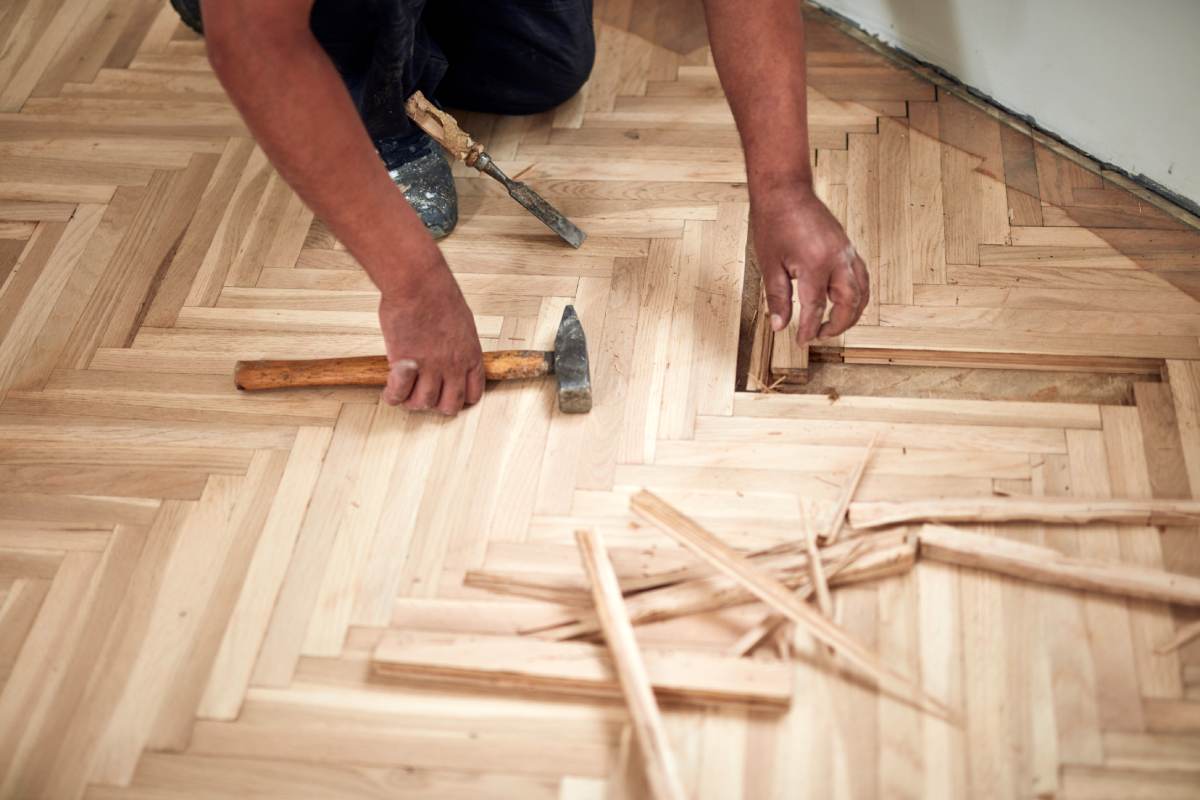
The fix starts under the boards. Loose pieces come up, the substrate gets flattened, and only then does the surface go back together — otherwise the same seam opens again by winter.
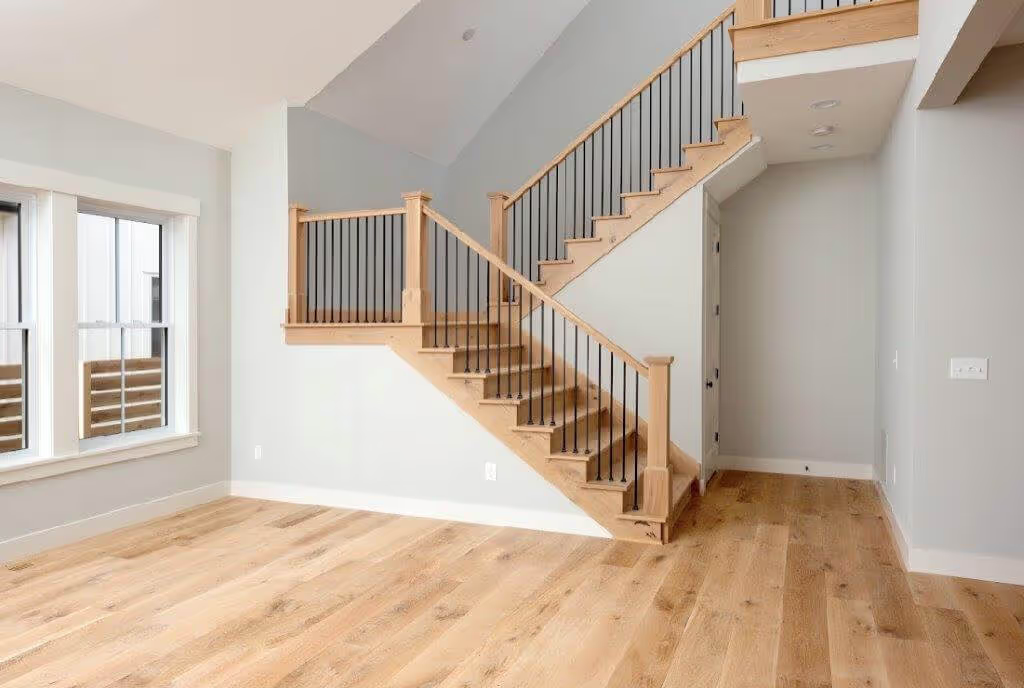
Stairs take the traffic of a hallway on a tenth of the wood. Treads, nosings and thresholds wear out years before the rooms around them — and they can be repaired one piece at a time.
Every morning run down Coal Creek Parkway to the freeway, every trip up from the garage with groceries, every muddy dog coming back off Cougar Mountain lands on the same few square feet of wood. Newcastle is a city of split-entries, daylight basements and three-level plans, which means more landings, doorways and stair nosings per house than almost anywhere on the Eastside — and those are the pieces that wear through first. These are the repairs people put up with for years because they assume the whole staircase has to come apart. It does not.
Photograph the damage on your phone — a close-up of the worst spot, one from a few feet back, and one of the whole room. One of our estimators looks at every photo personally and emails you a written price the same business day. No visit, no sales call, no obligation.