1,000+ Floors Installed & Restored Across Washington
Searching for floor repair near me in Renton? Cracked and water-marked boards come out, matching boards go in, and the floor you already own stays where it is. We repair hardwood, laminate and vinyl plank across Renton, from Kennydale and the Highlands down through Talbot Hill and Benson Hill. Call (425) 595-1079 for a free in-home estimate.




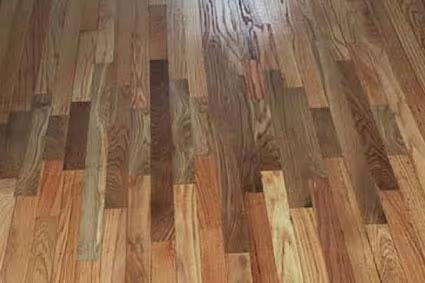
What a bad repair looks like. Wrong species, wrong grain, wrong color — patched by someone who didn't match the wood. You see it from the doorway, permanently.
Anyone can pull a damaged board and screw a new one down. Whether you notice the patch every day or forget where it was comes down to matching: species, grain, board width, thickness, stain and sheen. On Renton's older fir floors that margin is narrower than most people expect.
Renton takes water from several directions at once — the Cedar River, runoff off the hillsides, and the ordinary run of failed dishwashers and fridge lines. Cupped, swollen and blackened boards get cut out and replaced. We take a moisture reading underneath before we quote, and we do not lay new material over anything still reading wet, because that is how a repair comes apart a season later.
Lifted ends, cracked planks and seams that have crept open — the default problem in Renton's newer builds and rental units, where click LVP is on almost every floor. We work out why it moved before touching it: a floating run pinned by an island or a baseboard, a high spot underneath, or afternoon sun through a west-facing slider. Then individual planks come out and the seams close back up.
The Benson Hill and Fairwood subdivisions are full of laminate put down between the late nineties and the mid-two-thousands, and laminate cannot be sanded. So we unclick the run back from the nearest wall, pull only the swollen edges and chipped corners, and lock it together again. If there is a leftover box in your garage, the repair effectively disappears.
Split, cupped or stained hardwood cut out one board at a time and replaced with the same species, width and grain direction rather than whatever is closest on the shelf. Older Renton houses often have narrow vertical-grain fir instead of oak, and fir sands and takes stain differently, so we test the color on a spare board from your own floor before committing to it.
Claw marks running down a hallway, the gouge where a couch got dragged, grit ground into the finish inside the back door. Light damage buffs out and gets recoated in place; deep marks are filled or the board is swapped and blended into the surrounding finish. Worn thresholds where hardwood meets tile, carpet or LVP get re-cut so they sit flat and hold the plank edges down.
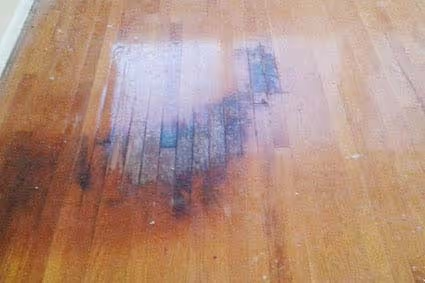
Pet urine and water rings soak through the finish into the wood itself, which is why cleaning never removes them. This is the actual sequence we run, photographed on our own jobs.
 1
1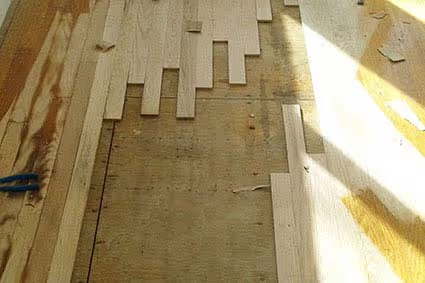 2
2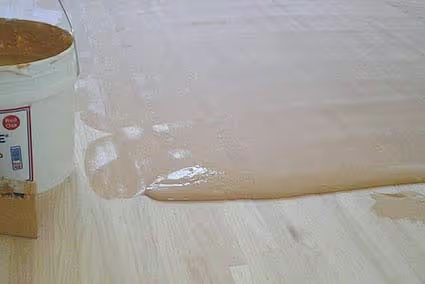 3
3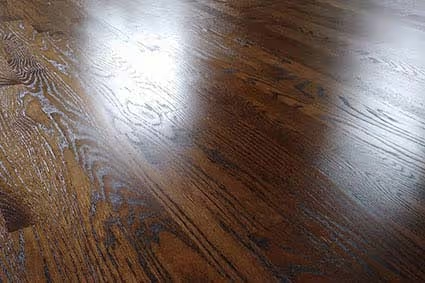 4
4Most pet-stain and water-damage repairs are finished in 1–2 days.
Two different jobs at two very different prices. Here is how to tell which one your floor actually needs — before anyone quotes you.
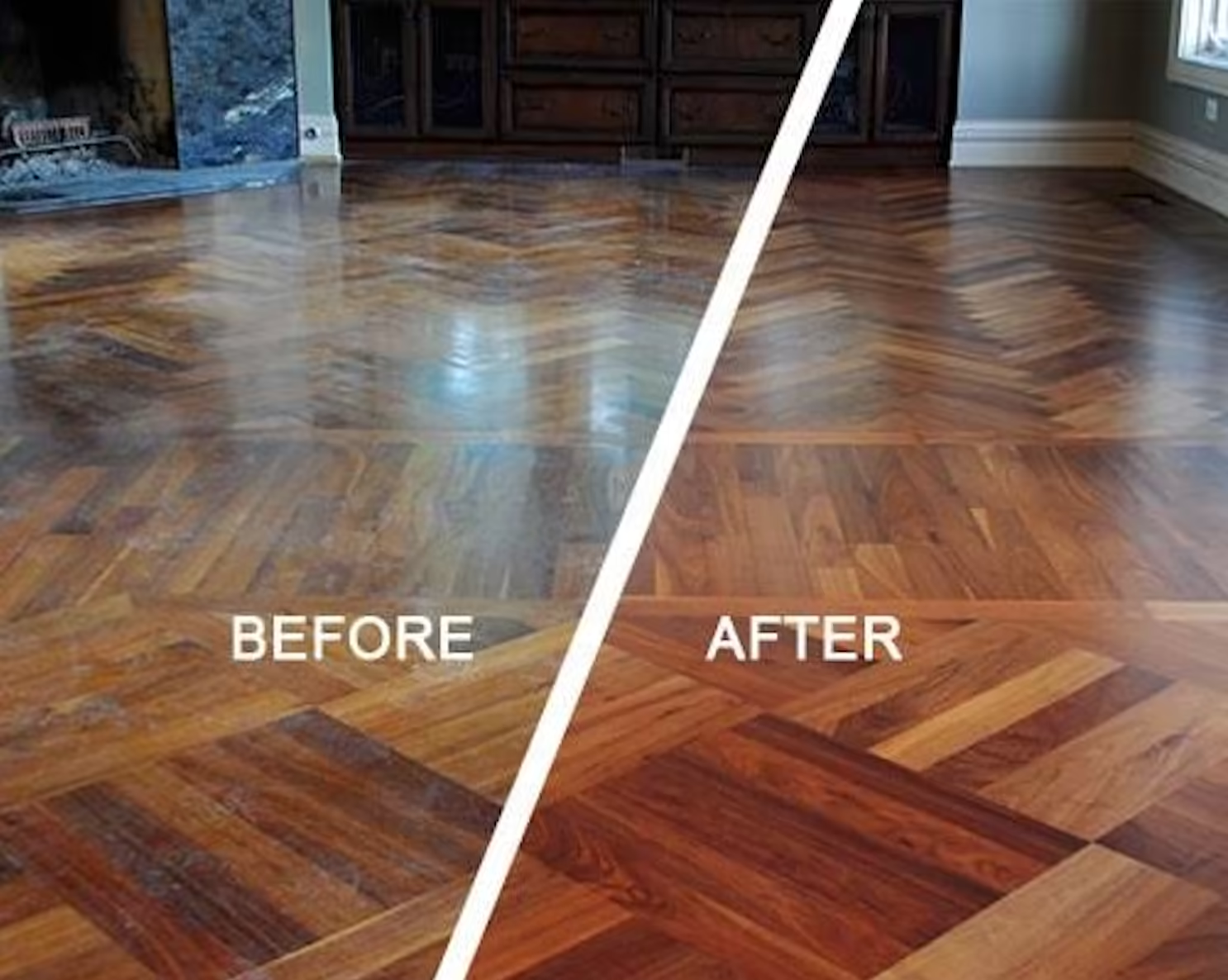
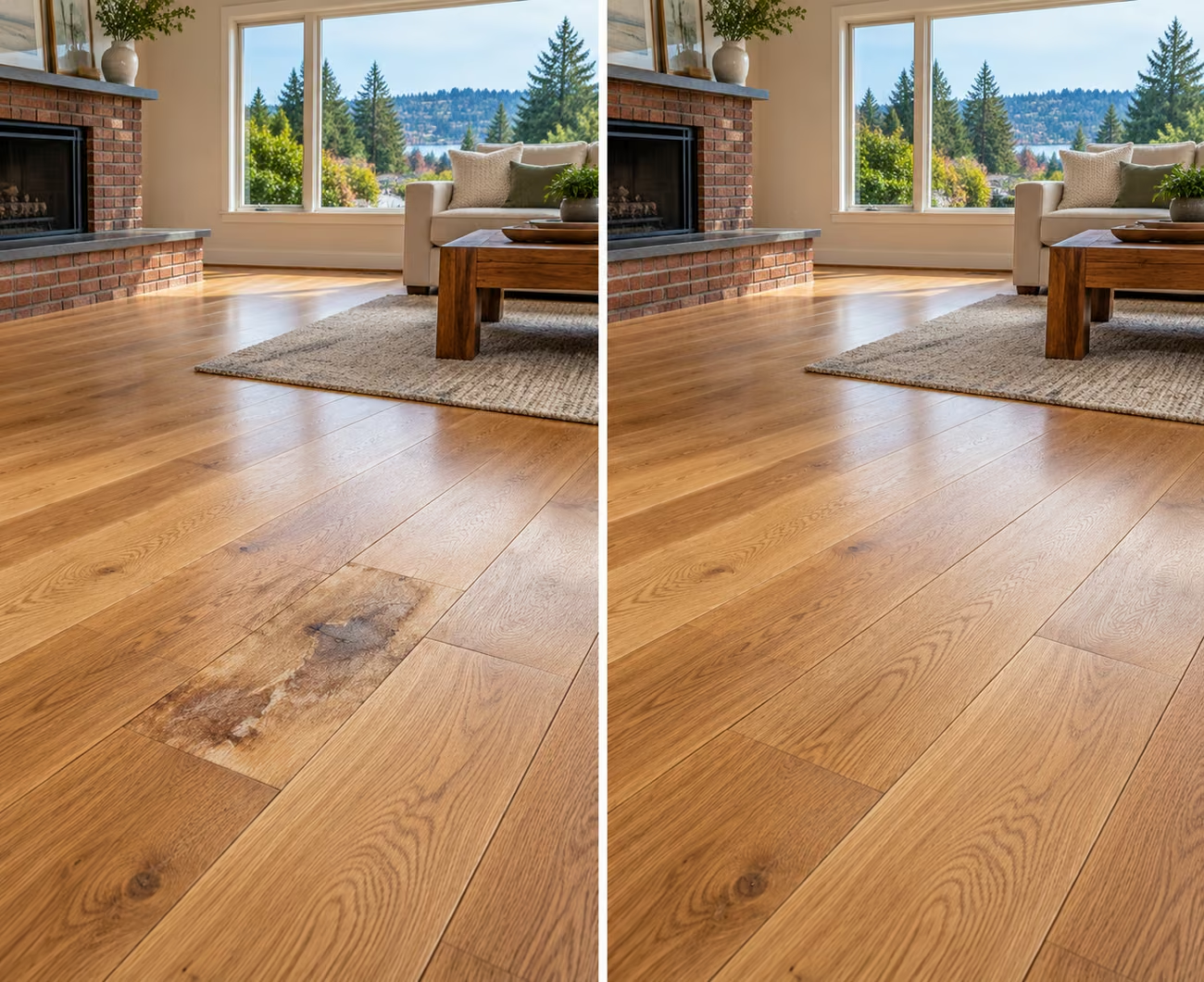
The same floor, split down the middle. Left: the finish is cloudy and worn through in the traffic path — no amount of patching fixes that. Right: sanded back and refinished.
Typically $200–$1,000 · most finished in 1–2 days
Board replacement is done first, so the whole floor is finished together
The water drop. Put a drop of water on a worn spot. If it beads, your finish is still doing its job — a spot repair is fine. If it soaks in within a minute, the finish is gone there and the floor is due for a refinish.
The window check. Crouch down and look along the floor toward a window. If scratches catch the light across the entire room, patching will not help — that is a refinish. If they are only in one area, repair that area.
Still not sure? Send us a few photos of the floor and we will tell you which one you need, even when it is the cheaper answer.
Renton is not one housing stock. It is four, laid on top of each other, and which one you live in decides what goes wrong with your floor.
Downtown and North Renton came first. The city incorporated in 1901 on coal and brick, with Pacific Car and Foundry arriving in 1905, and houses from the 1910s and 1920s are still standing on those blocks. Pull the carpet in one and what is usually underneath is narrow clear vertical-grain Douglas fir, the wood that was local and cheap at the time. Fir is softer than oak. It dents under a chair leg, it takes a pet stain quickly, and by now most of it has been sanded at least twice. We measure what is left above the tongue before we promise anything.
Up the hill to the east is the Highlands, and it exists because Boeing broke ground on the Renton plant in 1941 to assemble B-29s. Federal money under the Lanham Act put roughly 420 acres and more than two thousand units of worker housing up in a hurry, much of it built to be taken apart again once the war ended. It never was. Renton annexed the area in 1945, the houses were sold to the families living in them, and eight decades of covering, uncovering and re-covering have happened since. The Sunset Area has been rebuilt in waves since 2012, so a single street can hold a wartime house with fir under two layers of old vinyl and, across from it, a building finished last decade running click LVP wall to wall.
Then there is the bulk of the city, and the number that describes it best is the median build year: 1988. Benson Hill — annexed in 2008, more than 22,000 people, close to a quarter of Renton — along with Cascade, Tiffany Park, Renton Park, Rolling Hills, Spring Glen, and the Fairwood blocks that still sit in unincorporated King County despite carrying a Renton mailing address. These are subdivisions from the 1960s through the 1990s: plywood subfloor, wall-to-wall carpet, sheet vinyl in the kitchen. Nearly all of it has been updated at least once, and the update was laminate or engineered hardwood. Both have thin wear layers. Both get repaired by replacing planks, not by sanding, which is precisely the work we do most of out here.
And then there is water. The Cedar River runs through the middle of town on its way into Lake Washington, and it floods. Levees line the last mile and a quarter through downtown, which is the only reason the damage stops where it does. Add the Kennydale slope above the lake, where runoff finds the low corner of a daylight basement, and the ordinary Puget Sound stretch of rain from October through May, and water damage makes up a larger share of the repair calls here than it does further inland. It is also why a moisture reading comes before the quote on this side of the county, every single time.
One last thing shapes the job in Renton. Close to half of the city's households rent, and a large share of the housing is apartments rather than detached houses — the multifamily blocks in the Highlands, the buildings around The Landing, Southport out on the lake. Those floors are LVP almost without exception, and between tenants they need fast, clean plank swapping, not a week of sanding and a building full of people who cannot walk across their own living room.
A lot of the calls that reach us from Renton start with somebody else's quote for a whole new floor. Sometimes that quote is the right answer. More often it is not — a floor with one water-marked run by the slider, one dog-stained corner, or a dozen lifted planks down a hallway does not need replacing. It needs a crew that does this exact work every week: cut out what is damaged, match what goes back in, blend the finish until the repair stops being visible.
We are licensed and insured, locally owned, have been doing this since 2013, back our workmanship for a year, and have 103 five-star Google reviews from homeowners across King and Snohomish County. And if we look at your floor and conclude that replacement genuinely is the cheaper road, we will tell you that instead of selling you a repair.
Usually more than people expect. Solid hardwood that cupped from a short soak often flattens back out once the moisture underneath drops to normal, and only the boards that stayed wet longest need cutting out. Laminate is the least forgiving of the three — once the core swells at the edges it does not go back down. Vinyl plank generally survives the water itself; the issue is what got trapped beneath it. We take moisture readings before quoting anything, and we will not put new material over material that still reads wet.
Most of what we do lands between $200 and $1,000. What moves the number is how many boards or planks are coming out, whether we can match the material from stock or have to go hunting for it, and whether the repaired area needs staining and coating to blend with what surrounds it. A single gouged board by a doorway sits at the bottom of that range. A stained bedroom corner in old fir that needs color mixing and a finish blend sits near the top. Estimates are free and done in person.
Almost always. Click LVP floats, which means it has to be able to expand — when it cannot, the planks push against each other and one seam gives up first. So we look for what is pinning it before we look at the plank: an island screwed through the floor, baseboard nailed too tight, a heavy bookcase parked on the run, or a high spot underneath that needs flattening. Deal with the cause, lift the affected run back from the nearest wall, swap out what is damaged, re-lock it. Replacing the entire floor is very rarely the answer.
It changes several things. Fir was the standard floor in the houses built around downtown and North Renton before the war, and it is noticeably softer than oak — it dents more readily and it takes stain unevenly, which is why a poorly matched patch stands out on fir when the identical patch would vanish on oak. It has also typically been sanded more than once already. Before quoting a fir repair we check how much wood remains above the tongue, and we test stain on a spare board from your own floor rather than trusting a color chart.
Start with your own garage or crawlspace. A surprising number of homeowners out here still have the leftover box from the original install, and one box solves the entire problem. If there is none, we can harvest planks from inside a closet, under the refrigerator, or a corner permanently hidden by furniture, move those into the damaged area, and put the mismatch somewhere nobody looks. If neither route works, we will tell you honestly whether a close-but-not-exact plank will read as a patch or disappear.
Scratches, almost always. Stains, it depends on depth. Claw marks that only went through the finish come out with a buff and a recoat of that area. Once they have cut into bare wood, the board gets filled and blended or swapped outright. Dark stains are a different question: urine that sat on the surface often sands away, but once it has soaked through the grain and into the wood below, no amount of sanding takes it out and the board has to be replaced.
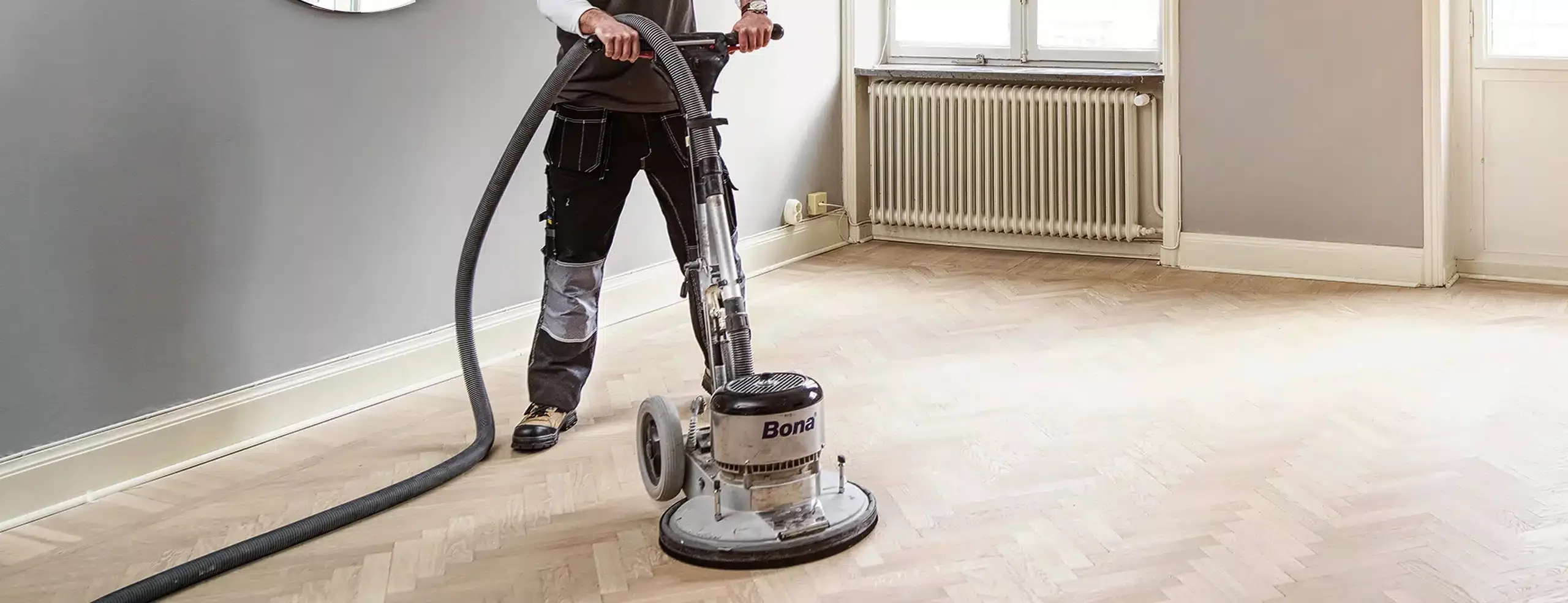
Solid wood keeps a reserve. A solid fir or oak board carries enough thickness to sand a problem out completely — which is why deep damage in an older Renton floor is often repaired in place instead of replaced.
Solid hardwood is the one floor with margin built in. Where an engineered plank has a millimeter or two of real wood on top, a vertical-grain fir board in a 1920s North Renton house can give up a full pass of sanding and still have years in it. The catch on this side of town is that most of those floors have already been sanded once or twice, so the reserve is real but finite — we measure what is left above the tongue before we promise anything. Then we ask whether the damage actually goes deeper than the finish, because a surprising amount of it does not.
The median Renton house dates to 1988, and the subdivisions through Benson Hill, Cascade and Tiffany Park went down as plywood over joists, which is exactly the age when fasteners start letting go. The wartime Highlands houses, put up fast in 1941, have their own version of the same story.
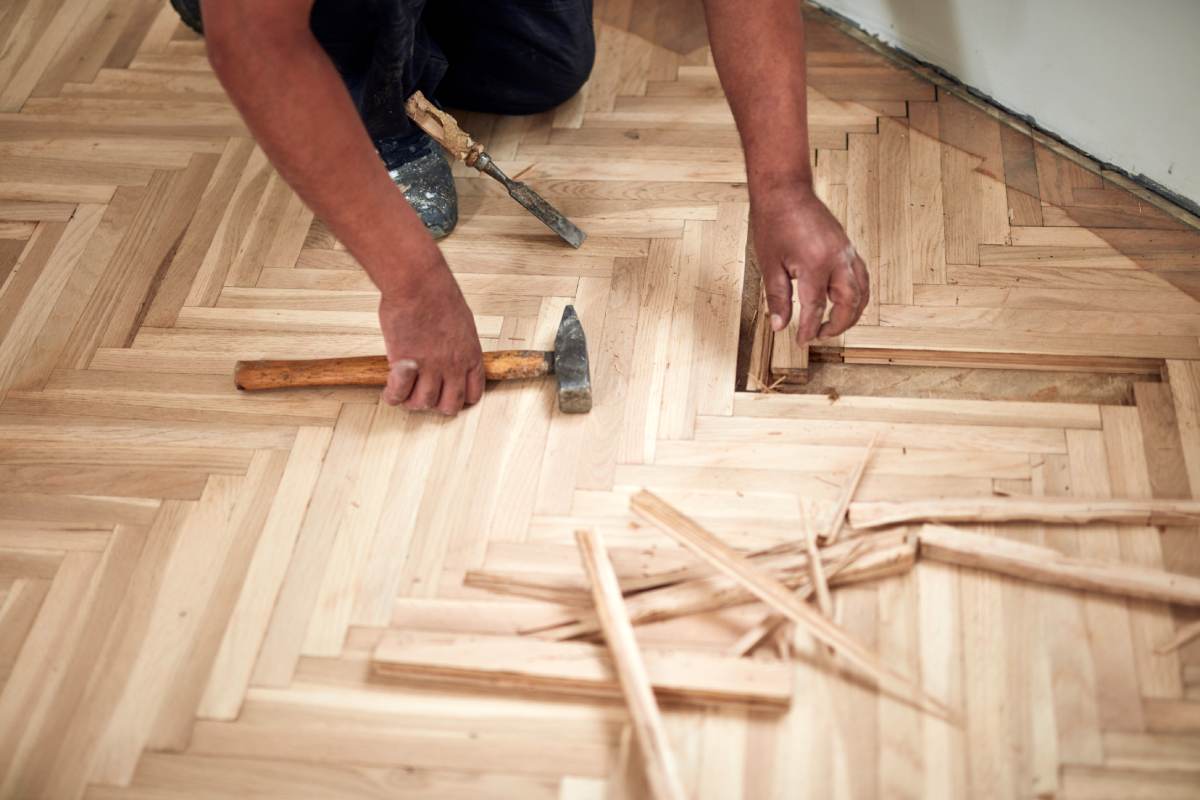
The fix starts under the boards. Loose pieces come up, the substrate gets fastened flat, and only then does the surface go back together.
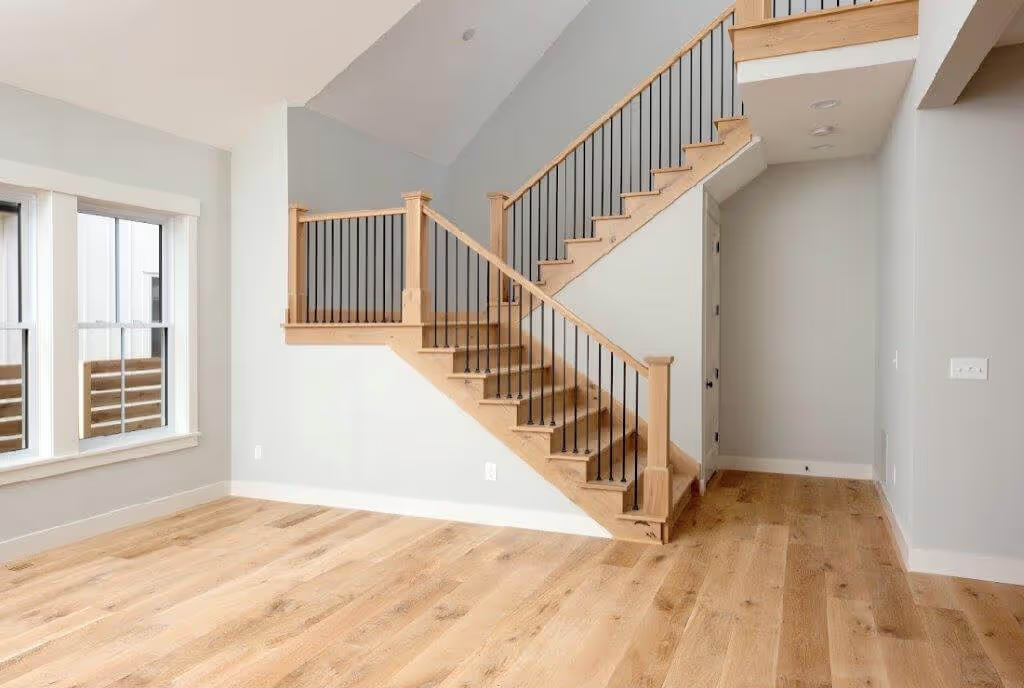
Stairs take the traffic of a hallway on a tenth of the wood. Treads, nosings and thresholds wear out years before the rooms around them — and they can be repaired one piece at a time.
Every early shift down to the Boeing plant, every school run off Talbot Hill, every wet dog coming back from the Cedar River lands on the same few square feet of wood. In a two-story house up in Rolling Hills or Fairwood the staircase is the busiest floor in the home, and the nosing on each tread takes the full strike of every step. Close to half of Renton's households rent, so in an apartment near The Landing those same treads also have to be right between tenants. These are the repairs people put up with for years because they assume the whole staircase has to come apart. It does not.
Photograph the damage on your phone — a close-up of the worst spot, one from a few feet back, and one of the whole room. One of our estimators looks at every photo personally and emails you a written price the same business day. No visit, no sales call, no obligation.