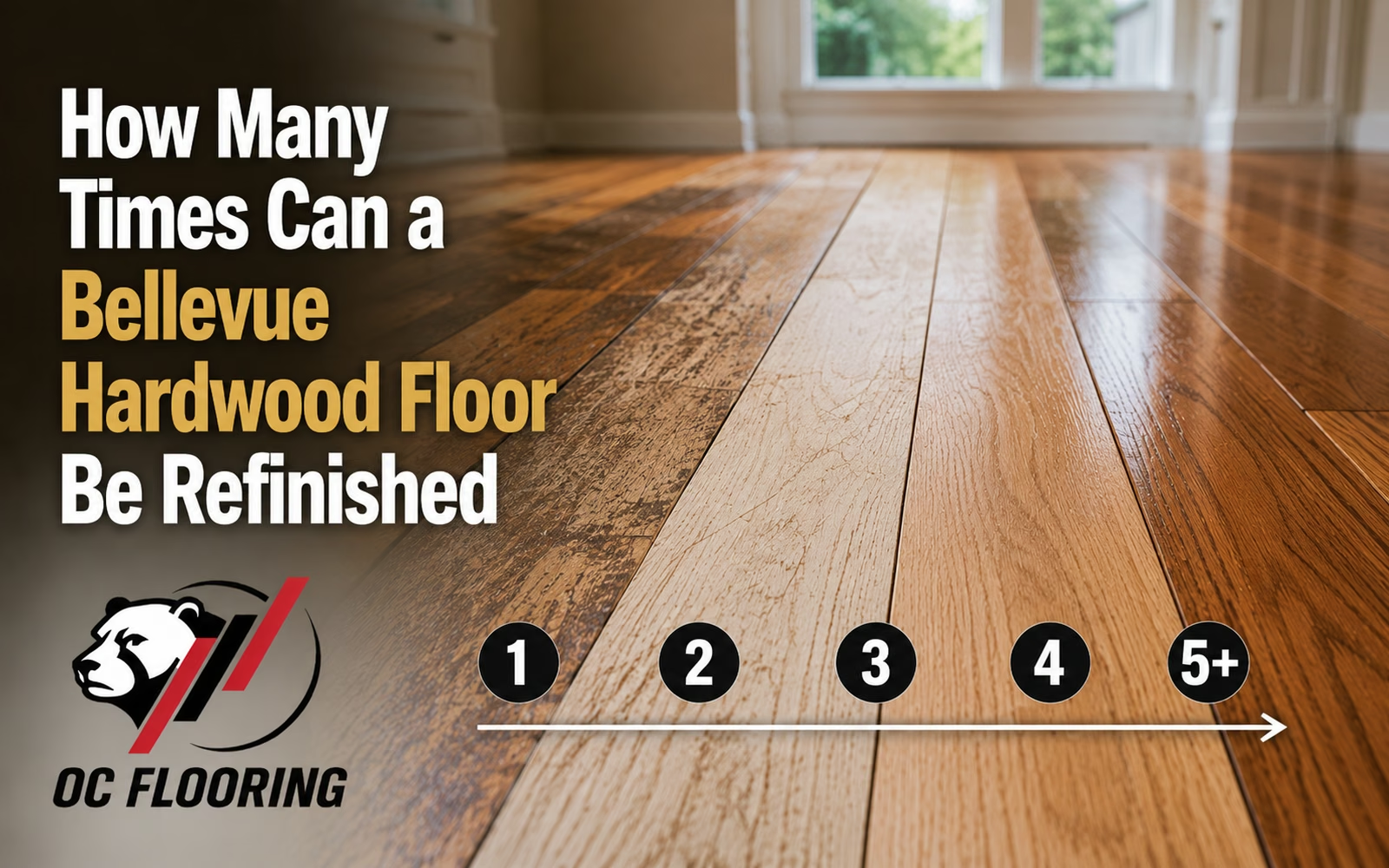




A solid ¾-inch hardwood floor can be fully sanded and refinished about 4–6 times over its life — each sanding removes roughly 1/32 of an inch, and the floor only has about ¼ inch of usable wood above the tongue. Most Bellevue floors, laid in the red oak boom of the 1980s through the 2000s, are on their first or second sanding and nowhere near that limit. Screen & recoats don’t count against the budget at all, engineered floors run a much tighter math, and a floor that’s been through a rental sander may have fewer sandings left than its age suggests. Here’s how to tell where yours stands.
This question usually arrives with a specific worry attached: “our floors were refinished before we bought the house, and maybe once before that — are we about to sand them out of existence?” Almost always, no. A solid hardwood floor is one of the few things in a house designed to be renewed repeatedly, and the arithmetic is more generous than most homeowners fear. But the arithmetic is real — a floor does carry a finite budget of wood, some things spend it faster than others, and a small share of the floors we look at genuinely are on their last sanding. This article is the math we do at the estimate, written down.
One framing that helps: think of the wood above the tongue as a savings account. It opened with about a quarter inch in it. Every full sanding is a withdrawal of a thirty-second or so. Screen & recoats are free — they refresh the finish without touching the wood. And a bad DIY weekend with a rented drum sander can be the largest single withdrawal the account ever sees.
full sand-and-refinish cycles in a typical solid ¾-inch hardwood floor — enough to renew it every decade or two for the better part of a century.
wood a professional full sanding removes — about 1 mm. Flattening deep damage, cupping, or a botched previous job can double that.
our screen & recoat — the maintenance move that renews the finish while withdrawing exactly zero wood from the floor’s budget.
The Wood Budget: What Your Floor Has to Spend
A standard solid hardwood board is ¾ of an inch thick, but you can’t sand through all of it. About halfway down sits the tongue-and-groove joint that locks the boards together, and on a nail-down floor, the nails ride just above the tongue. The wood that can actually be sanded — the “wear layer,” to borrow the engineered-flooring term — is the top ¼ inch, give or take. Sand past it and two things happen in quick succession: nail heads start surfacing through the floor, and the tongue joint weakens until boards flex and crack. That’s the true end of a floor’s life.
Divide ¼ inch by the 1/32 inch a careful professional sanding removes and you get eight on paper. In practice the honest number is four to six, because not every sanding is minimal: a floor with deep scratches, pet stains, or cupping has to be sanded flat, not just clean, and flattening spends extra wood. A floor refinished every 15 years or so — a realistic interval when it’s maintained properly between sandings — can outlast the mortgage, the roof, and possibly the house’s second kitchen remodel.
What One Refinish Actually Removes — and Why It Varies
“About 1/32 of an inch” assumes the job is done well: sequenced grits, a flat machine, an operator who removes only what the floor requires. Our final pass runs through a Lägler TRIO, a three-disc planetary sander whose whole purpose is precision — taking the floor dead flat without digging. That’s the minimal-withdrawal scenario.
The expensive scenarios are the ones where the sander has to chase a problem downward. Deep gouges, sun-fade that penetrated the stain layer, urine shadows, and cupped boards all force more aggressive cuts, because the floor isn’t renewed until the lowest point of the damage is gone. A cupped floor is the classic example: the board edges sit higher than the centers, and sanding it flat means cutting the entire surface down to the level of the valleys — sometimes a sixteenth of an inch, two withdrawals in one visit. It’s one reason we tell homeowners that fixing the moisture problem before sanding a cupped floor isn’t just sequencing — it protects the wood budget too.
What Uses Up Sandings Faster Than It Should
Three culprits account for nearly every prematurely thin floor we meet. The first is rental-sander weekends. A drum sander in inexperienced hands cuts fast and unevenly, and the classic outcome — visible dips and chatter marks — then requires a professional flattening that spends another healthy layer of wood to erase. We’ve measured floors that lost two or three sandings’ worth of thickness to one long weekend.
The second is refinishing too often for the wrong reason. A floor that just looks dull or has fine surface scratches doesn’t need sanding at all — that’s a screen & recoat, which abrades only the finish and lays a fresh coat over it. At $1.99/sq ft it’s less than half the cost of a $3.99/sq ft full refinish, and it draws nothing from the wood budget. The decision logic between the two is its own article — buff and coat vs full sand — but the one-line version is: sand when damage is in the wood, recoat when it’s only in the finish.
The third is aggressive or careless past work — a contractor who started at too coarse a grit, or sanded a floor that only needed a recoat. You can’t undo a previous owner’s choices, but you can find out what they left you, which brings us to the useful part.
How to Tell How Many Sandings Your Floor Has Left
You don’t have to guess, and you don’t have to pull up a board. The easiest window into a floor’s thickness is a heating vent: lift the register and look at the exposed cross-section of the boards at the cutout. You’ll see the full board profile — measure or eyeball the wood above the tongue. Around ¼ inch means a floor with most of its life ahead; an eighth of an inch means one, maybe two careful sandings remain; anything less is recoat-only territory.
Other signals we read at estimates: nail heads glinting anywhere in the field of the floor (a floor at the end of its budget), a springy or flexing board underfoot (weakened tongues), and the depth of the “reveal” under baseboards compared to closets that were never sanded. If several of these show up together, the floor may be one of the genuine exceptions where sanding is no longer safe — we’ve written about when wood floors can’t be refinished, and thin stock tops that list. The good news: a too-thin floor isn’t necessarily a dead floor. It’s a floor whose maintenance strategy shifts permanently to recoats, which can keep a healthy finish on an eighth of an inch of oak for decades.
How many sandings are left? A field guide
| Floor | Usable wood | Full sandings left | Smart strategy |
|---|---|---|---|
| Solid ¾″, never sanded | ~¼″ above the tongue | 4–6 | Sand when damage demands; recoat between |
| Solid, sanded once or twice | ~1/8–3/16″ | 2–4 | Same — budget is still healthy |
| Solid, thin (nails showing, boards flex) | <1/16″ | 0–1, expert call | Recoat-only; repair or replace worst boards |
| Engineered, 4–6 mm wear layer | 4–6 mm veneer | 2–3 | Treat almost like solid, but verify first |
| Engineered, 3–4 mm wear layer | 3–4 mm veneer | 1–2 | Sand once, then recoats for life |
| Engineered, <2 mm wear layer | Too little | 0 | Recoats only — sanding risks the core |
The Bellevue Ledger: Young Floors, Deep Budgets
Bellevue is one of the best-positioned cities in our service area on this question, and the housing stock explains why. The great majority of Bellevue hardwood went down between the 1980s and the 2000s — solid red oak, Janka 1290, nailed over plywood in the neighborhoods that filled in around the tech boom. A 1995 floor is barely thirty years old. Even if it was refinished once before a sale, it’s carrying four or five sandings of wood — its budget is essentially full. The Bellevue floors we see with genuine thickness problems are almost always the outliers: a rental-sander experiment somewhere in the floor’s past, or older midcentury stock near Lake Washington that’s been worked several times.
The other Bellevue wrinkle is newer construction and condos, where “hardwood” is often engineered — solid math doesn’t apply there, as the next section covers. If you’re unsure which you own, the vent trick answers it in thirty seconds: engineered boards show plywood layers in cross-section, solid boards show one continuous piece of oak. We refinish throughout Bellevue and the Eastside — the same crews that handle hardwood floor refinishing in Seattle and Kirkland — and the Bellevue verdict at estimates is, far more often than not, “this floor has decades left.”
Engineered Floors Run a Different Ledger
Everything above assumes solid wood. Engineered hardwood — a real-wood veneer over a plywood core — carries only its veneer as a budget, and that changes the numbers completely: a 3–4 mm wear layer affords one or two careful sandings, a premium 4–6 mm layer behaves almost like solid, and anything under 2 mm should never meet a sander at all. The full decision tree, including how to measure your wear layer without tearing up a board, is in our guide to whether engineered hardwood can be refinished. The strategic difference is worth stating plainly: on a solid floor, a recoat is smart maintenance; on an engineered floor, it’s the whole preservation plan.
Refinishing Limits: What Bellevue Homeowners Ask Us
How many times can solid hardwood be refinished?
Does a screen and recoat count as one of those times?
How do I find out how thick my floor still is?
What happens if a floor gets sanded too many times?
My floor was refinished before we bought the house. Should I worry?
Do engineered floors follow the same rules?
How often should a floor actually be refinished?
Does refinishing more gently cost more?
Want to Know What Your Floor Has Left?
We’ll check the thickness, tell you honestly whether it needs a sand, a recoat, or nothing yet — and put the numbers in writing. Free in-home estimates across Bellevue, the Eastside, and King & Snohomish County.
Related reading: Engineered hardwood and the wear layer · Buff and coat vs full sand · When wood floors can’t be refinished · 2026 refinishing cost guide · Book a free estimate