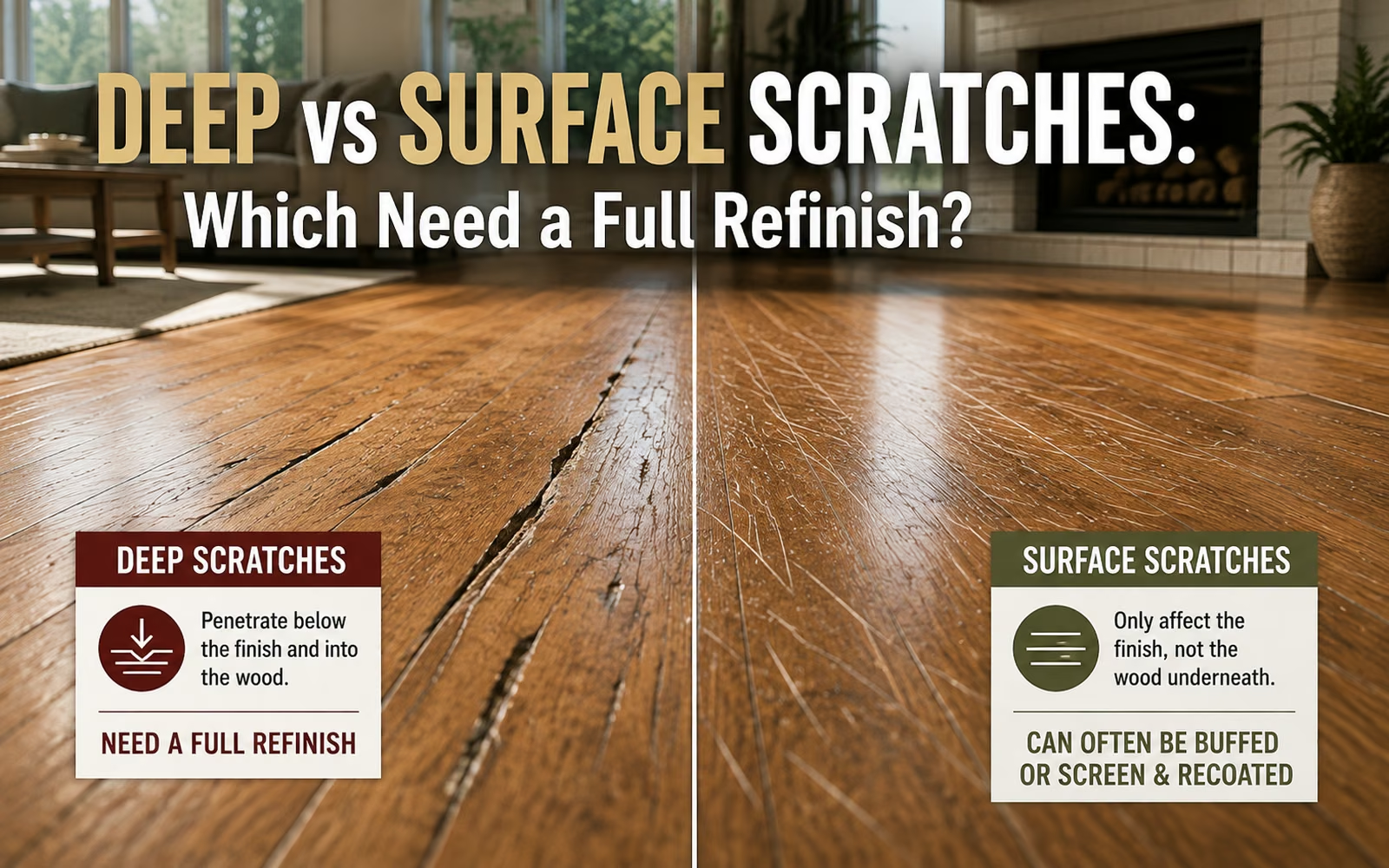




A buff and coat renews the finish — $1.99/sq ft, one day — and a full sand renews the floor — $3.99/sq ft, 3–5 days; the right one depends entirely on whether your damage stops at the finish and whether you can live with the current color. Finish intact, color fine: buff and coat, no contest. Bare spots, deep scratches, gray boards, or a color change: only a full sand does it, and buffing first just spends money twice. For Sammamish’s 1990s–2000s housing stock the split lands in a specific, predictable way — we’ll get to that.
“Buff and coat” and “screen and recoat” are the same service wearing different names — we abrade the existing finish with a fine screen or buffer pad and lay a fresh coat of finish over it, never touching wood. A full sand is the other thing entirely: machines take the floor down to bare wood, erasing finish, damage, and color in one pass, and we rebuild from zero. One is maintenance; the other is a reset.
The comparison matters because the two get sold interchangeably, and they shouldn’t be. A buff and coat quoted for a floor with bare spots is money burned; a full sand quoted for a floor that needed a $1.99 recoat is over-treatment at double the price. We’ve written the general comparison before; this version adds the decision tests we actually run at estimates, the ten-year cost math, and the Sammamish-specific pattern we see on the plateau.
buff and coat — screen the finish, apply a fresh commercial waterborne topcoat. One day, socks the same evening, furniture back in 48–72 hours.
full sand with natural finish — down to bare wood, Lägler TRIO flattening pass, 2–3 new coats. Typically 3–5 days; $6.50/sq ft if you’re staining.
the recoat cadence that keeps a healthy floor out of sanding territory indefinitely — a floor only has so many full sands in it, and not spending them is the win.
What Each One Actually Does
A buff and coat treats the finish as what it is — a renewable wear layer. The screening removes the scratched, dulled top skin of the old polyurethane and gives the new coat something to grip; the fresh coat then restores thickness, sheen, and protection. Everything below the finish is untouched, which is precisely its power and its limit: the floor keeps its color, its patina, its flatness — and also its deep scratches, its gray spots, and every other flaw that lives in the wood.
A full sand removes the entire finish and a thin slice of wood with it, which is why it can erase what a recoat can’t: wear-through, deep scratches, sun fade, water marks, an outdated stain color. The floor that emerges is effectively new material — we flatten it with a Lägler TRIO final pass and build a fresh 2–3 coat waterborne system on it. The costs are the obvious one (price and 3–5 days of disruption) and a quieter one: each full sand spends a portion of the floor’s finite wood, and a solid floor has maybe four to six sandings in its lifetime. Sanding a floor that needed a recoat isn’t just triple the price — it’s withdrawing from a account you can’t refill.
The Candidacy Test: Five Questions, Two Minutes
Whether a buff and coat is even on the menu comes down to five checks. One: is the finish intact everywhere? Drop water on the worst traffic areas — if it soaks in and darkens the wood anywhere, the film is breached and screening is off the table. Two: is the damage finish-deep? Scratches your fingernail glides over will screen out; grooves that catch it won’t — the full triage is in our deep vs surface scratches guide. Three: do you like the color? A recoat locks in the current look; any color change means sanding. Four: what’s been put on the floor? Wax, polish, oil soaps, and certain “rejuvenator” products leave residues that stop new finish from bonding — the honest risk in this trade, and the reason we ask about your cleaning products before quoting. Five: has it been recoated recently with unknown products? Adhesion over a mystery finish gets tested, not assumed.
Fail any of the five and the answer is a full sand — not because we prefer the bigger ticket, but because a recoat that peels or seals in damage is the most expensive cheap job in flooring. Pass all five and a full sand would be over-treatment; we’ll say that just as plainly.
Buff and coat vs full sand, line by line
| Buff and coat | Full sand & refinish | |
|---|---|---|
| Price | $1.99/sq ft | $3.99/sq ft natural; $6.50 with stain |
| Time | 1 day | 3–5 days |
| Removes | Finish scratches, dullness, minor wear | Everything — damage, fade, old color |
| Can change color | No | Yes — stain or natural, your call |
| Dust | Minimal | Managed; containment available +$250 |
| Wood consumed | None | One of the floor’s finite sandings |
| Back to normal | Socks same evening; furniture 48–72h | Socks same evening after final coat; rugs 7 days |
| Fails when | Wear-through, deep damage, residues | Wood too thin — rare, but checkable |
The Ten-Year Math
Here’s the comparison that actually matters, because nobody buys one floor service in isolation — you buy a decade of floor condition. Take 1,000 sq ft. Strategy A, maintenance: buff and coat every four years — three services in a decade at $1,990 each, roughly $6,000, and the floor never looks worse than “lightly used” while its sandable wood sits untouched. Strategy B, neglect and reset: do nothing until year eight or nine, when the traffic lanes have worn through and gone gray, then pay $3,990 for the full sand the neglect made mandatory. Cheaper on paper — until you price the years of tired floors, the week of disruption, and the sanding you just spent from the floor’s lifetime budget.
The honest wrinkle: Strategy A only works if you start while the floor still qualifies. Most homeowners call us at the exact moment the floor crosses from recoat-able to sand-only — that’s not a coincidence, it’s the definition of “when it started bothering you.” If your floors look generally good and merely dull, you’re in the cheap window right now. If you’re seeing bare wood, the window closed, and pretending otherwise wastes your money. The full cost guide has every number for both paths.
Buff and coat wins when…
- Water beads everywhere — the finish film is intact
- Damage is dullness and fine scratching, not grooves or gray
- You like the floor’s current color and sheen
- The floor has only ever seen proper finishes, not wax or polish
- You want it done in a day for half the price
Full sand wins when…
- Any spot has worn through to bare or gray wood
- Scratches catch a fingernail or cut through a stain color
- You want a different color — or to erase an ambered old finish
- Water marks, sun fade, or pet stains live in the wood
- Residues or a mystery previous coating make adhesion a gamble
The Sammamish Pattern: Plateau Floors at Twenty-Five
Sammamish’s housing stock is unusually uniform — the plateau filled in fast through the 1990s and 2000s, and those builder-grade homes came with two flavors of hardwood: site-finished red oak in the earlier waves, and factory-finished (prefinished) oak in the later ones. Both are now twenty to thirty years old, which is exactly the age where the buff-and-coat-versus-full-sand question stops being theoretical. The site-finished oak is the easy case: if it’s never worn through, it screens and recoats beautifully, and we do a steady business in exactly that service across Klahanie, Sahalee, and the Trossachs-era developments.
The prefinished floors need one honest asterisk: their beveled board edges and factory aluminum-oxide coatings make recoating a more careful job — the screen has to abrade a very hard finish without burning through on the bevels — and adhesion gets verified, not guessed. It’s absolutely doable, full sanding included, but it’s a different procedure than site-finished oak and it’s worth hiring someone who treats it that way. Either way, the assessment is the same free visit — details on our Sammamish refinishing page.
Buff and Coat vs Full Sand: What Homeowners Ask Us
What's the difference between buff and coat and screen and recoat?
How do I know if my floor qualifies for a buff and coat?
Why can't you buff out deep scratches or gray spots?
How long does each option take?
How often should floors get a buff and coat?
Can a buff and coat change my floor's sheen?
Why did a contractor quote me a full sand when the floor looks fine?
Is a buff and coat worth it on a floor we'll refinish eventually anyway?
Which One Does Your Floor Need? Ask the Water Drop — Then Ask Us
We’ll run the candidacy checks in person and quote both numbers honestly — the $1.99 day or the $3.99 reset, whichever your floor actually calls for. Free estimates across King & Snohomish County.
Related reading: Sand & refinish vs screen & recoat · Deep vs surface scratches · How many times can a floor be sanded? · Hardwood floor refinishing in Sammamish · Book a free estimate