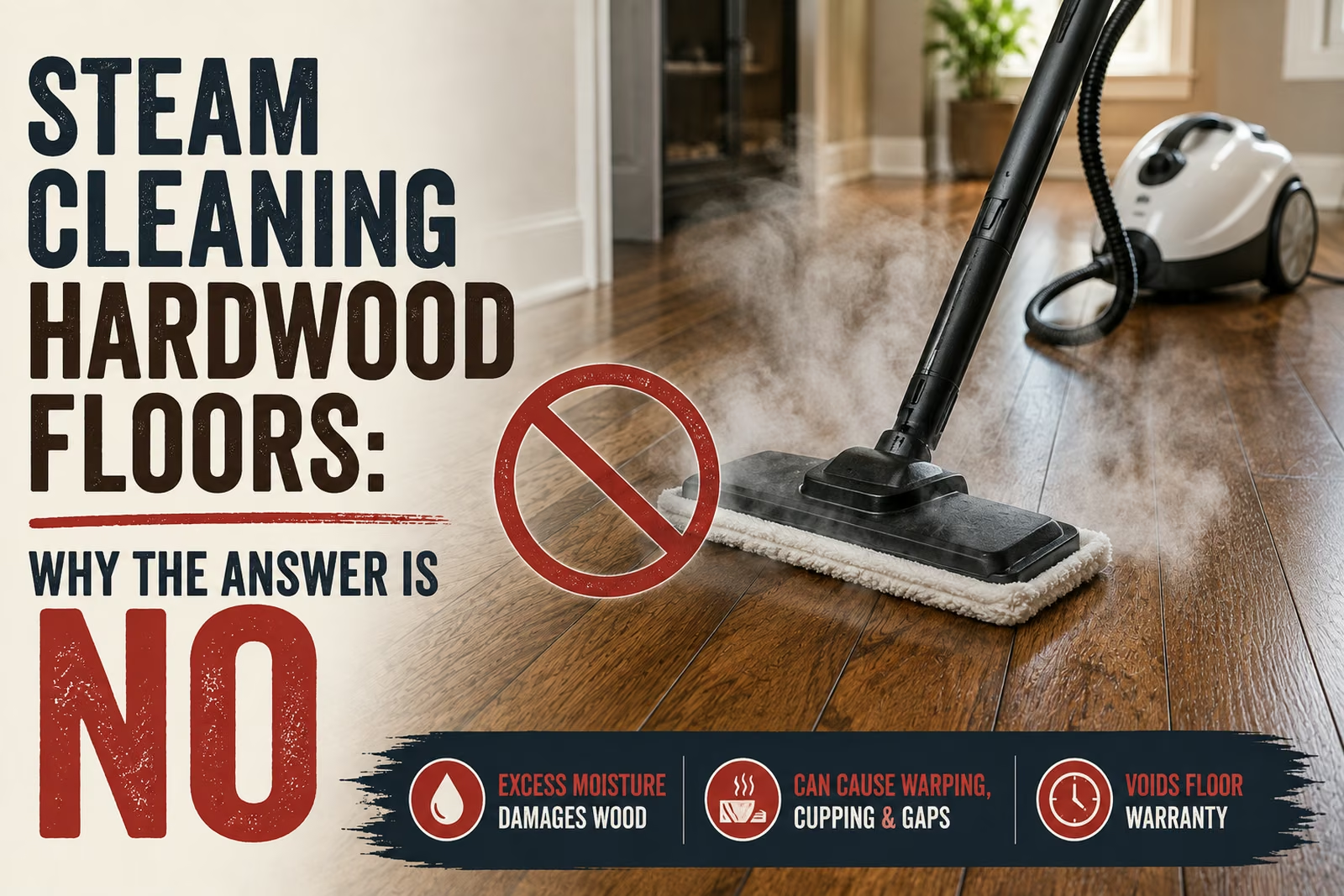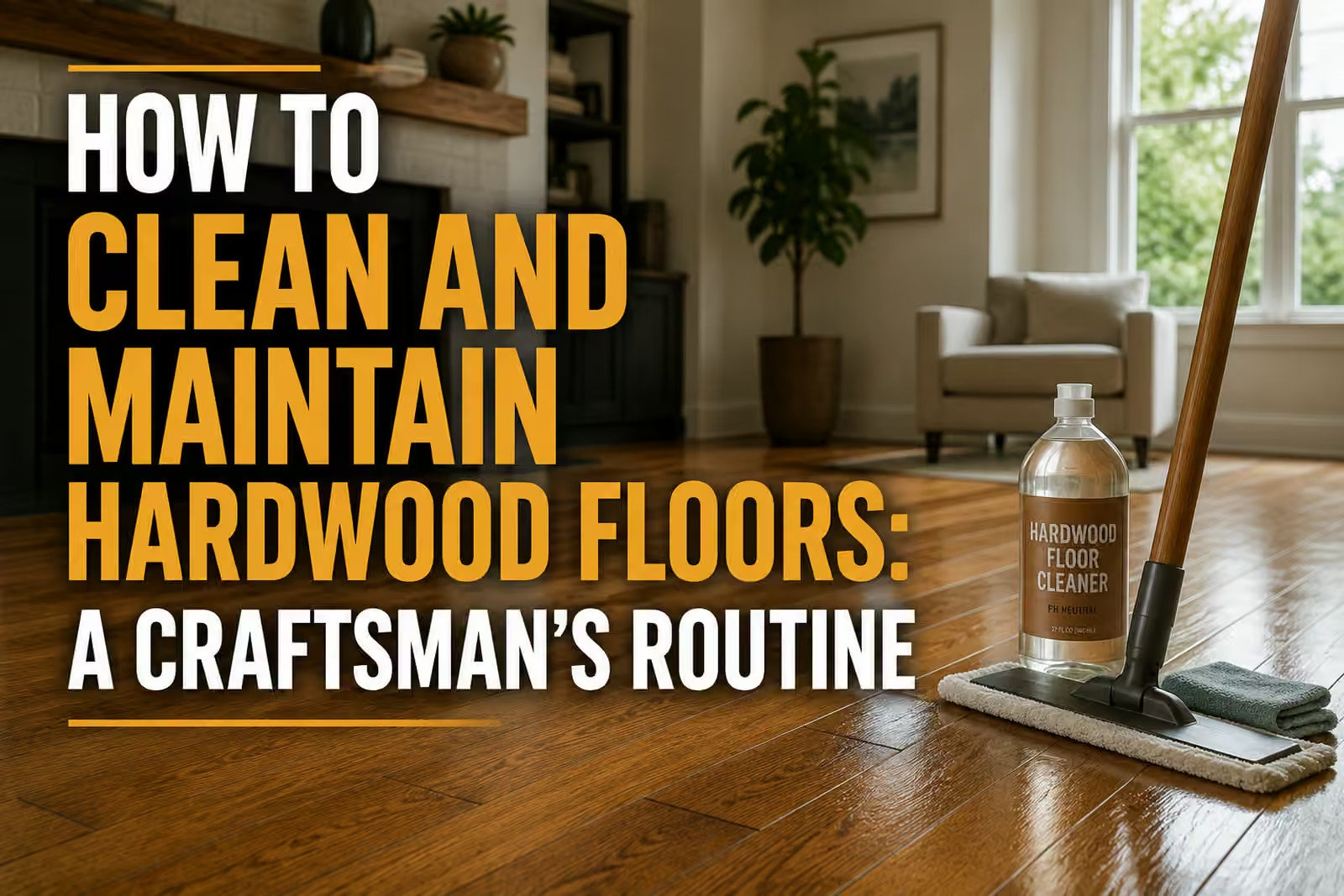




Clean a refinished hardwood floor with a dry microfiber dust mop and a pH-neutral hardwood cleaner — and nothing else. No steam mop, no vinegar, no oil soap, no “rejuvenating” polish. Those four products cause most of the damaged-finish calls we get from Redmond homes, and none of that damage is covered by a workmanship warranty — ours or anyone else’s. The good news: the safe routine is also the cheapest one, and it takes about ten minutes a week. Here’s the full rulebook, starting with the first-week schedule that matters most.
We give every client the same short speech on the last day of a refinish, usually while the final coat is still curing behind us. It boils down to this: the floor you just paid for will look this good for a decade with almost no effort — and it can be dulled, clouded, or contaminated in one enthusiastic afternoon with the wrong bottle from the cleaning aisle. The products that do the damage are all marketed for hardwood floors, which is exactly why people trust them.
There’s a warranty angle here too, and we’d rather draw the line clearly now than argue about it at your kitchen table later. Our one-year workmanship warranty covers our work: adhesion, coverage, sanding quality. It cannot cover what a steam mop or an acrylic polish does to a finish — and neither can any finish manufacturer’s warranty. This article is the honest version of what’s covered, what isn’t, and the routine that keeps the question from ever coming up.
for a waterborne finish to fully cure. Socks the same evening, furniture at 48–72 hours — but rugs, damp mopping, and cleaning products all wait the full week.
our workmanship warranty on every refinish. It covers how we sanded and coated your floor. It can’t cover steam, wax, or oil-soap damage — which is why this article exists.
what a screen and recoat costs when a finish gets dulled — a real bill that a $10 bottle of the right cleaner avoids entirely.
What the Warranty Actually Covers — and What It Can’t
A workmanship warranty covers things that are the contractor’s fault. If a coat peels because of an adhesion failure, if sanding marks telegraph through the finish under afternoon light, if the film didn’t level — that’s on us, and we come fix it. What no contractor covers, and no finish manufacturer covers either, is damage done to the finish after we leave: moisture forced into the seams by a steam mop, a soft acrylic film laid on top by a “restorer” product, a sheen chemically dulled by months of vinegar. This isn’t fine print looking for an exit. The two kinds of damage look completely different under inspection — a workmanship defect follows the pattern of our work; product damage follows the pattern of a mop. We’ve honored plenty of warranty calls, and the distinction has never been hard to make.
The First Week Is Its Own Rulebook
The waterborne systems we coat with — Bona and Pallmann, two to three coats — are dry enough for socks the same evening, but the film keeps hardening for about seven days. During that window: furniture back at 48–72 hours, lifted into place rather than dragged; rugs wait the full week so the film can finish curing evenly; and cleaning means a dry dust mop only. No liquid touches the floor in week one — not even the good cleaner. The full schedule, hour by hour, is in our guide to walking on refinished floors. Most cure-window damage we see isn’t dramatic; it’s a rug pad texture faintly printed into a finish that was five days old.
The Only Routine Your Floor Needs
After the cure, maintenance is genuinely simple. A dry microfiber mop through the traffic areas every day or two picks up the grit that does the actual damage — dirt underfoot works like sandpaper, and it scratches finish faster than any dog. Once a week or so, a pH-neutral hardwood cleaner: mist it onto the mop pad, not onto the floor, and the floor should be dry within a minute of the pad passing. That’s the entire program. Add felt pads under furniture legs, walk-off mats at exterior doors, and trimmed pet claws, and you’ve done everything our floor-protection checklist asks of anyone. Our longer cleaning and maintenance guide covers the edge cases, but the honest summary is: the less product you use, the better your floor does.
The maintenance calendar we give clients
| How often | What | Why |
|---|---|---|
| Every day or two | Dry microfiber dust mop in traffic areas | Grit underfoot is what scratches finish — this removes it |
| Weekly-ish | pH-neutral hardwood cleaner, misted on the pad | Lifts the film of daily life without attacking the finish |
| Seasonally | Check felt pads, door mats, pet claws | Ninety percent of scratches come from these three sources |
| Every 3–5 years | Screen and recoat — $1.99/sq ft | A fresh wear coat before the old one wears through |
| Every 15–25 years | Full sand and refinish | Only when wear has reached the wood itself |
The Blacklist, and What Each Product Actually Does
Steam mops are the worst offender because they feel virtuous — no chemicals, just water. But that water is vapor under pressure, and it drives moisture through the seams between boards and into the finish film itself, clouding it white and swelling the wood below. We wrote a whole post on why steam and hardwood don’t mix; the short version is that no finish manufacturer permits it. Vinegar is an acid, and a diluted acid mopped over a floor weekly dulls the sheen slowly enough that most people blame the finish. Oil soaps leave a residue that smears underfoot, grabs dirt, and builds up with every wash. None of these ruin a floor in a day — that’s what makes them dangerous. They ruin it over a year, and by then the receipt is long gone.
Why “Polish” and “Restorer” Products Are the Expensive Mistake
The acrylic “hardwood polish” bottles promise to bring back the shine, and for a weekend they do — by laying a thin coat of soft plastic over your actual finish. That layer scuffs faster than real finish, goes cloudy in traffic lanes, and here’s the part the label never mentions: nothing bonds to it. The normal maintenance move for a dulling floor is a screen and recoat — abrade the old coat, lay a fresh one, $1.99/sq ft, one day. A floor with acrylic polish on it can’t be recoated until the residue is stripped, because new finish peels off contamination — and if stripping doesn’t get it all, the fix becomes a full $3.99/sq ft resand. A $12 bottle quietly doubles the cost of your floor’s next maintenance visit. If a product’s label says “restores shine,” put it back on the shelf.
Redmond Floors Live Hard Lives
Redmond is where we most often see great floors under heavy use: 1990s–2000s tech-era homes around Education Hill and Grass Lawn with open great rooms, which concentrate every footstep, dog lap, and rolling office chair onto one continuous stretch of hardwood. Add a retriever who does Marymoor twice a week and kids in cleats, and a Redmond floor can see more traffic in a year than a formal-living-room floor sees in ten. That’s not an argument for exotic products — it’s an argument for the boring routine done consistently, plus a recoat every few years before wear reaches wood. It’s also why we coat with commercial-grade waterborne like Bona Traffic HD in the first place. If your floor is past the point where cleaning helps, our hardwood floor refinishing in Redmond page covers what a reset costs.
Safe for a waterborne finish
- Dry microfiber dust mop — as often as you like
- pH-neutral hardwood cleaner (Bona, Pallmann, or equivalent)
- A barely-damp mop pad — dry within a minute behind you
- Felt pads, breathable rug pads, walk-off mats
- A screen and recoat every 3–5 years
Keep it off the floor
- Steam mops — moisture driven into seams, voids every warranty
- Vinegar or ammonia mixes — acids and alkalis dull the sheen
- Oil soaps — residue that smears and blocks future recoats
- Acrylic “polish” or “restorer” — soft plastic nothing bonds to
- Wet mopping — standing water finds every seam
Cleaning Refinished Floors: What Redmond Homeowners Ask Us
Will using a steam mop actually void my warranty?
What cleaner do you actually recommend?
Can I use a vinegar-and-water mix like my parents did?
How soon after refinishing can I mop?
Are wet Swiffer-style pads safe?
How do I get scuff marks off without damaging the finish?
My floor went dull and sticky after years of an oil soap. Can it be fixed?
Do rugs need special pads on a refinished floor?
Floor Past the Point Where Cleaning Helps?
A screen and recoat at $1.99/sq ft resets the wear layer in a day — and we’ll tell you honestly if that’s all you need. Free in-home estimates across King & Snohomish County.
Related reading: Can you steam clean hardwood floors? · Cleaning and maintaining hardwood floors · When you can walk on refinished floors · Hardwood floor refinishing in Redmond · Book a free estimate