


On a typical refinish we run three machines: a belt sander for the main cut, an edger for the perimeter, and a Lägler TRIO planetary sander for the final flattening pass — and the drum sander, the machine most people picture, is the one we don’t use, because it’s the machine that gouges floors. Drum, belt, and orbital aren’t three brands of the same thing; they’re three different cutting actions with different failure modes, and which ones your Everett contractor owns tells you a lot about the floor you’ll get. Here’s the honest tour of the equipment.
Nobody hires a flooring contractor because of their sander — until they’ve seen what the wrong sander does. Chatter marks that appear only in afternoon light, a dished stripe where a machine sat spinning, edger swirls haloing every wall: nearly all of the “can you fix what happened to my floor” calls we take trace back to equipment, or to technique the equipment demanded and didn’t get. So this is the article we wish homeowners could read before comparing bids: what each type of floor sander actually does, why the differences show up in your finish months later, and what we run on our own jobs.
A note on words, because the industry is sloppy with them: people say “drum sander” for any big walk-behind machine. Strictly, a drum sander wraps a sheet of abrasive around a solid rotating drum; a belt sander runs a continuous abrasive loop over a roller system. They look similar from six feet away, and they cut very differently. That distinction is roughly half this article.
on a typical refinish: a belt sander for the field, an edger for the perimeter, and the Lägler TRIO for the final flattening pass. No single machine does all three jobs well.
a typical grit progression, coarse to fine, across multiple passes. Each grit erases the scratches of the one before — skipping grits is how finishes end up hazy.
Janka hardness of the old-growth Douglas fir in Everett’s mill-era homes — soft enough that an aggressive drum machine can do a decade of damage in one pass.
The Three Machines, in Plain English
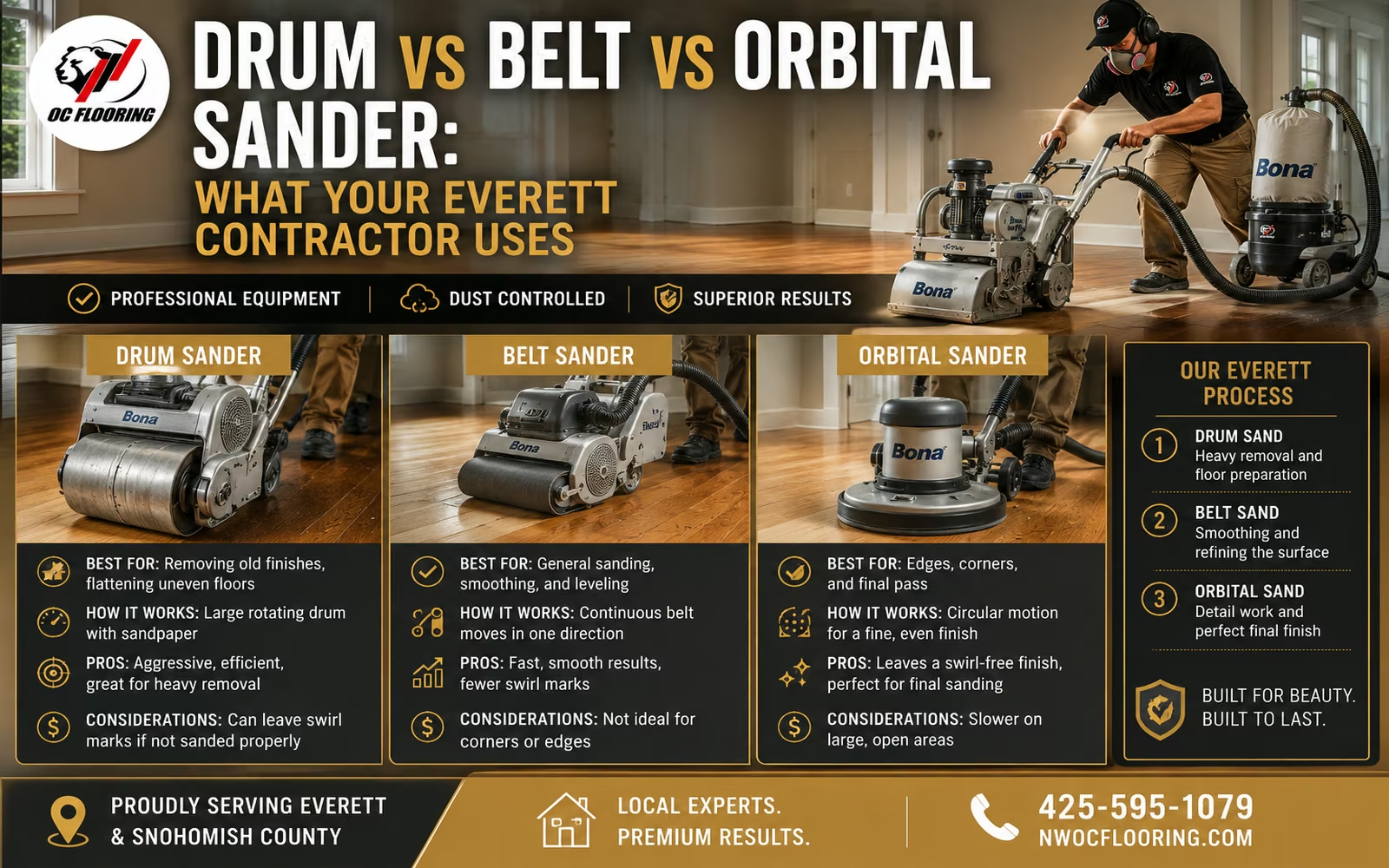
Drum sanders are the blunt instrument: abrasive wrapped on a rigid, fast-spinning drum, cutting hard exactly where the drum touches. Enormous material removal, zero forgiveness — hesitate for one second and the drum digs a hollow you’ll see forever; a wave in your walking rhythm becomes a wave in the floor, called chatter. This is the machine rental shops carry. Belt sanders are the professional standard for the main cut: a continuous abrasive belt over a drive system, usually with better drive control and dust pickup. The action is smoother and more even than a drum’s, tracking is self-correcting, and stop marks are far harder to make. It still removes wood fast — it’s just governable. Orbital and planetary sanders cut with rotating pads instead of a spinning cylinder: slow removal, almost impossible to gouge. A rental orbital can’t realistically strip a worn floor — people run out of patience two hours into the first room — but as a finishing action, multi-head planetary machines are superb, which brings us to the TRIO.
Drum vs belt vs orbital, side by side
| Drum sander | Belt sander | Orbital / planetary | |
|---|---|---|---|
| Cutting action | Abrasive on a rigid spinning drum | Continuous belt over rollers | Rotating pads or discs |
| Removal speed | Very fast | Fast, controllable | Slow |
| Gouge risk | Extreme — one pause is permanent | Low in trained hands | Nearly nil |
| Signature failure | Stop marks, chatter waves, dished spots | Operator-dependent, rare | Haze or swirl if run wrong, fixable |
| Best role | Legacy tool; what rental shops stock | The main cut on a professional job | Final flattening and blending passes |
| Who runs one | DIY renters, mostly | Professional crews | Professionals (TRIO) and cautious DIYers |
Why Rental Drum Sanders Wreck Floors
The physics is unforgiving arithmetic: a drum spinning at full speed removes wood continuously, so the only way to sand flat is to keep the machine moving at a perfectly steady rate — starting the drum already in motion, never pausing, feathering every pass into the last. Professionals build that rhythm over hundreds of floors. A first-timer meets it on their own living room, and the tuition is permanent: a moment’s pause at the wall while checking the cord, and there’s a hollow; an uneven walking pace, and the floor ripples with chatter that only appears once finish and low light arrive. We wrote the longer case in why refinishing isn’t a DIY project, and it’s not gatekeeping — it’s that the rental counter hands out the least forgiving machine in the trade to the least practiced operators, every weekend. When a rental-sander floor comes to us afterward, the fix is sanding past the damage, which spends wear thickness the floor can never get back.
Where the TRIO Fits: the Pass That Makes Floors Flat
After the belt sander has done the heavy lifting and the edger has handled the perimeter, the floor is stripped — but it isn’t yet flat in the way finish will reveal. Belt and edger leave slightly different scratch patterns, and their boundary can telegraph as a subtle halo around the room once sheen goes down. That’s the job of the Lägler TRIO, the planetary machine we run as a final pass: three counter-rotating discs under a heavy machine that ride the floor’s true plane, erasing directional scratches and unifying field and edge into one surface. It’s slow, it does nothing dramatic, and it’s the difference between a floor that looks refinished and a floor that looks new. It’s also a genuine tell when comparing contractors — a crew that owns a planetary finishing machine has invested in the boring last ten percent, which is where refinishing quality actually lives.
The Sequence We Actually Run — and Where the Dust Goes
A typical floor gets a grit ladder, coarse to fine — 36 to start if the floor carries old finish or deep wear, stepping through the grits to 100 — with each pass existing to erase the scratches of the pass before. Skipping a grit saves an hour and leaves scratches the finish will magnify forever; it’s one of the invisible corners a low bid can cut. The edger works the perimeter at matching grits, the TRIO ties everything together, and vacuum-assisted machines capture dust at the cut — with full plastic containment available at a flat $250 for clients who want the house sealed off room by room. The details of what “dustless” does and doesn’t mean are in our dustless vs traditional sanding comparison; the honest version is that modern pro equipment captures the overwhelming share of dust at the source, and containment handles the rest.
The Everett Factor: Soft Old Fir Doesn’t Forgive Equipment Mistakes
Everett’s older housing — the mill-era stock near downtown and Riverside, and plenty of homes out toward Silver Lake — sits on some of the softest flooring we work: old-growth Douglas fir, Janka 660, roughly half the hardness of red oak’s 1290. On wood that soft, every equipment sin doubles. A drum machine that would leave faint chatter in oak leaves washboard in fir; an edger run a grit too coarse swirls it visibly; even a belt sander needs a lighter touch and a smarter grit ladder than oak demands. This is why we’re emphatic about machine choice in Everett specifically — the same crew, same machines, same habits that handle Bellevue oak can genuinely damage a Delta Neighborhood fir floor if nobody adjusts. Our guide to refinishing old fir floors covers the species side, and our hardwood floor refinishing in Everett page has local pricing — $3.99/sq ft natural, same as everywhere we work.
Signs the equipment — and the crew — are right
- A belt machine for the field, not a rental-grade drum
- A planetary finishing pass (Lägler TRIO or equivalent)
- A stated grit sequence — they can tell you the ladder
- Vacuum-assisted dust capture, containment offered explicitly
- They adjust the plan when they hear “Douglas fir”
Signs of a rental-grade job ahead
- One machine is doing the whole floor, edges included
- No mention of grit progression at all
- “We’ll see how it goes” as a dust plan
- A bid far under market with no equipment story
- Fresh gouge repairs described as “normal sanding marks”
Floor Sanders: What Everett Homeowners Ask Us
What's the actual difference between a drum sander and a belt sander?
Can I refinish my own floor with a rented orbital sander?
What is a Lägler TRIO and why do you keep mentioning it?
What are chatter marks and can they be fixed?
Why does the grit sequence matter so much?
Do you sand the edges with the same machine?
Is sanding fir different from sanding oak?
How much dust does professional sanding actually make?
Want the Flat-Floor Version of Your Floor?
Belt machine, matched edger work, and a TRIO finishing pass on every refinish — $3.99/sq ft natural, quoted free and in writing. Serving Everett and all of King & Snohomish County.
Related reading: The Lägler TRIO and why flat floors matter · Why refinishing isn’t a DIY project · Dustless vs traditional sanding · Hardwood floor refinishing in Everett · Book a free estimate