


With the waterborne finishes we use, the refinishing smell is mild — a faint, slightly sweet “wet paint” note after each coat that fades within hours to a day with normal ventilation — because products like Bona Traffic HD carry only about 65 g/L of VOCs. The legendary knock-you-over “polyurethane smell” comes from a different product entirely: oil-modified poly at roughly 450–550 g/L, which fills a house for days and keeps off-gassing through a month-long cure. Which finish your contractor sprays decides which experience you get — so ask before you book, not after you smell it.
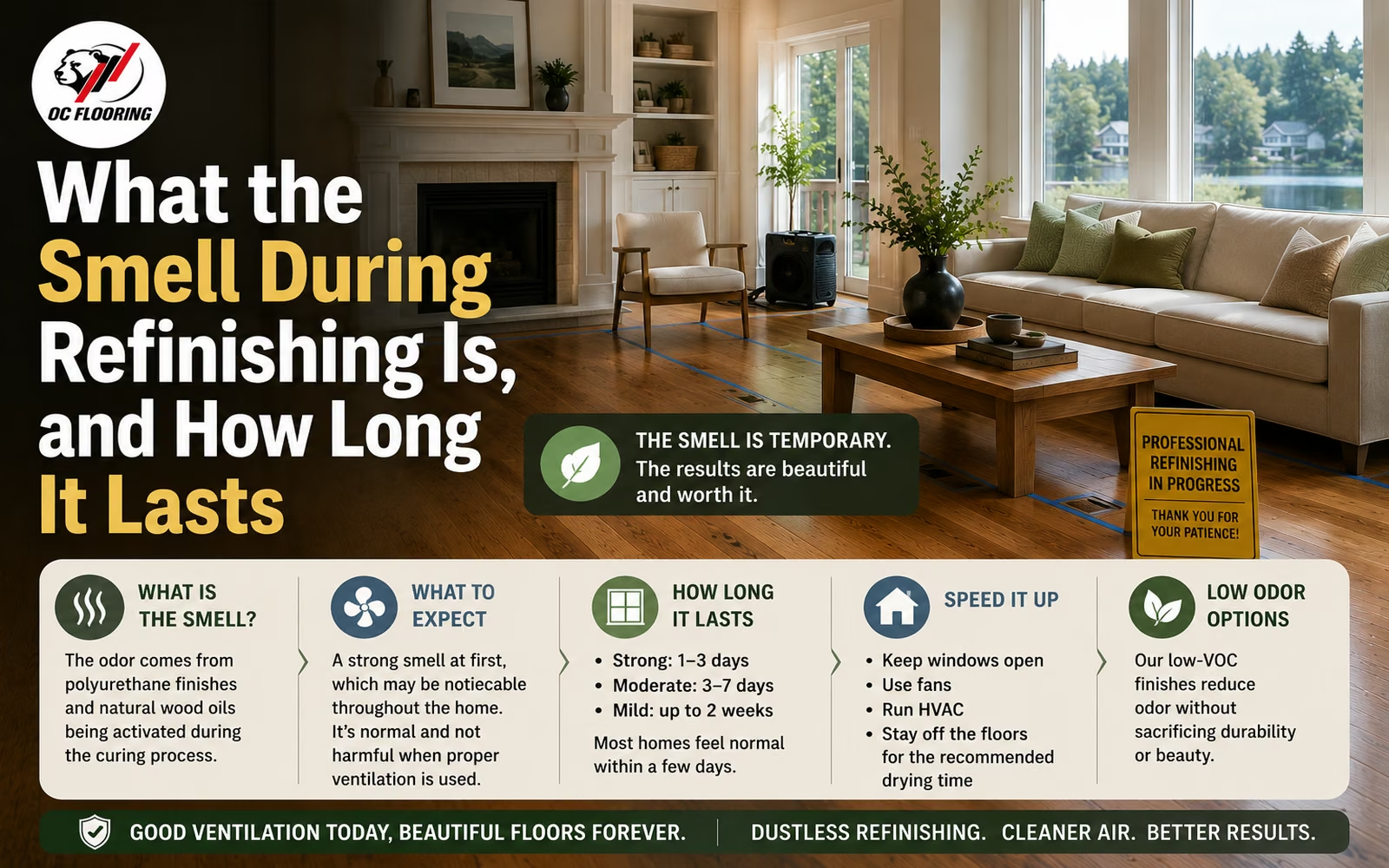
“How bad is the smell?” is a top-five estimate question, and it deserves a real answer instead of a wave of the hand — because the honest answer is “somewhere between barely-there and book-a-hotel, depending entirely on the products.” People who refinished floors in the 1990s, or last year with a bargain contractor, remember a solvent cloud that chased them out of the house. People whose floors we coated last week usually describe the smell as less than a room being painted. Both memories are accurate; they’re just memories of different chemistry. Here’s the full tour of what your nose meets during a refinish, stage by stage, and how long each part actually lingers.
VOC content of Bona Traffic HD, the GREENGUARD Gold–certified waterborne we coat most floors with. Oil-modified poly runs roughly 450–550 g/L — about seven times more solvent going into your air.
how long the mild smell of a waterborne coat typically hangs around with windows cracked and air moving. Most of our clients sleep home, in the house, the same night.
how long oil-modified poly keeps curing — and quietly off-gassing — after the crew leaves. Waterborne finishes reach full cure in about 7 days, and their smell is gone long before that.
Where the Smell Comes From, Stage by Stage
A refinish has three smell sources, and they’re not equally guilty. Sanding produces almost no odor — fresh-cut wood dust smells like a lumberyard, which most people mildly enjoy, and with the vacuum-assisted equipment we run (the details are in our dustless vs traditional sanding post) very little of it stays airborne anyway. Stain, if you’ve chosen color, is the strongest single day of a modern job: most pigmented stains are still solvent-carried, and the day the floor is stained your house smells unmistakably like a woodshop. It’s a one-day event that tapers as the stain dries. Finish coats are where the chemistries part ways completely — a waterborne coat smells faintly sweet and slightly ammonia-ish for a few hours; an oil-modified coat smells like a paint store with the doors locked, for days, times three coats. The table below lays the whole schedule out.
The smell timeline, both chemistries
| Stage | What you smell | How long it lingers |
|---|---|---|
| Sanding (day 1–2) | Fresh-cut wood, faint and pleasant | Gone when the dust is — hours |
| Stain day (optional) | Solvent / woodshop, the strongest day of a waterborne job | Strong for a day, tapering over 1–2 more |
| Waterborne coats (2–3) | Mild sweet “wet paint,” slight ammonia note | A few hours per coat; near-zero next morning |
| Waterborne cure | Faint to none | Fully cured and odor-free in ~7 days |
| Oil-poly coats (if used) | Heavy solvent fumes through the whole house | Days per coat — and it’s one coat per day |
| Oil-poly cure | Diminishing solvent smell that resurfaces in warm rooms | Off-gasses for weeks across a ~30-day cure |
The Numbers Behind Your Nose
What you’re smelling is VOCs — volatile organic compounds, the solvents that evaporate out of a finish as it dries. The number that predicts your week is grams per liter: the waterborne systems we use (Bona Traffic HD, Pallmann) sit around 65 g/L, while oil-modified polyurethane runs roughly 450–550. That’s not a marketing gap, it’s a sevenfold difference in what’s leaving the can and entering your air. It’s also why Traffic HD carries GREENGUARD Gold certification — a third-party indoor-air standard strict enough to cover schools — and why the full water-based vs oil-based comparison keeps coming back to livability. One vocabulary distinction worth having: dry is when the smell stops being obvious; cured is when the chemistry finishes. A waterborne floor is walkable in socks the same evening and fully cured in about a week. Oil poly stays chemically busy — and intermittently smellable, especially in warm sunlit rooms — for around a month.
Kids, Lungs, Pregnancy, and the Family Bird
For most healthy adults, the smell of a low-VOC waterborne job is a nuisance on par with painting a bedroom. The calculus tightens for infants, pregnancy, asthma, and anyone chemically sensitive — and it tightens hard for birds, whose respiratory systems are famously fragile around fumes of any kind. Our standing advice, spelled out in our guide to low-VOC refinishing with kids and pets: with our waterborne systems, most families stay home for the whole job, keeping sensitive members and pets out of the freshly coated rooms for the day; with any oil-based product, sensitive households shouldn’t be in the house during coating days at all, and birds should board elsewhere until the smell is fully gone. If someone in your home is in the sensitive column, say so at the estimate — it affects which product we spec and how we sequence rooms, and it’s exactly the planning problem our occupied-home scheduling guide exists to solve.
How to Clear the Smell Faster (and What Doesn’t Work)
Three things genuinely help. Air exchange: once a coat has set up enough that dust isn’t a threat — we’ll tell you when — cracked windows and a fan moving air out of the room beat any other trick. Warmth: finishes cure faster in a comfortably heated house than a cold one, and faster curing means a shorter smell tail; don’t shut the heat off to “save it for later.” Time with the HVAC fan on: circulating air through the system’s filter turns the whole house into a slow air scrubber. What doesn’t work: candles and sprays (they add smells, remove nothing), bowls of vinegar or onion (folk chemistry), and ozone generators (genuinely hazardous around people, pets, and fresh finish — hard no). And a scheduling note for our climate: in a Puget Sound winter, “open the windows” is a less charming instruction than in July, which is one of several reasons the smell conversation is also a season conversation. Wherever you are in our service area — our Seattle refinishing crews field this question daily — the answer scales with ventilation, not with worry.
Smell Questions Homeowners Ask Us Before Refinishing
Is the smell during floor refinishing dangerous?
Can we sleep in the house the night a coat goes down?
How long until the smell is completely gone?
What exactly is that smell?
Does the sanding part smell?
Do pets need to leave the house?
Does GREENGUARD Gold mean the finish is odorless?
What can we do to air the house out fastest?
Want the Low-Odor Version of This Project?
Tell us about your household — kids, lungs, pets, birds and all — and we’ll spec the finish system and schedule around it, with every number in writing. Free estimates across King & Snohomish County.
Related reading: Low-VOC refinishing with kids and pets · Water-based vs oil-based finish · When you can walk on refinished floors · Hardwood floor refinishing in Seattle · Book a free estimate