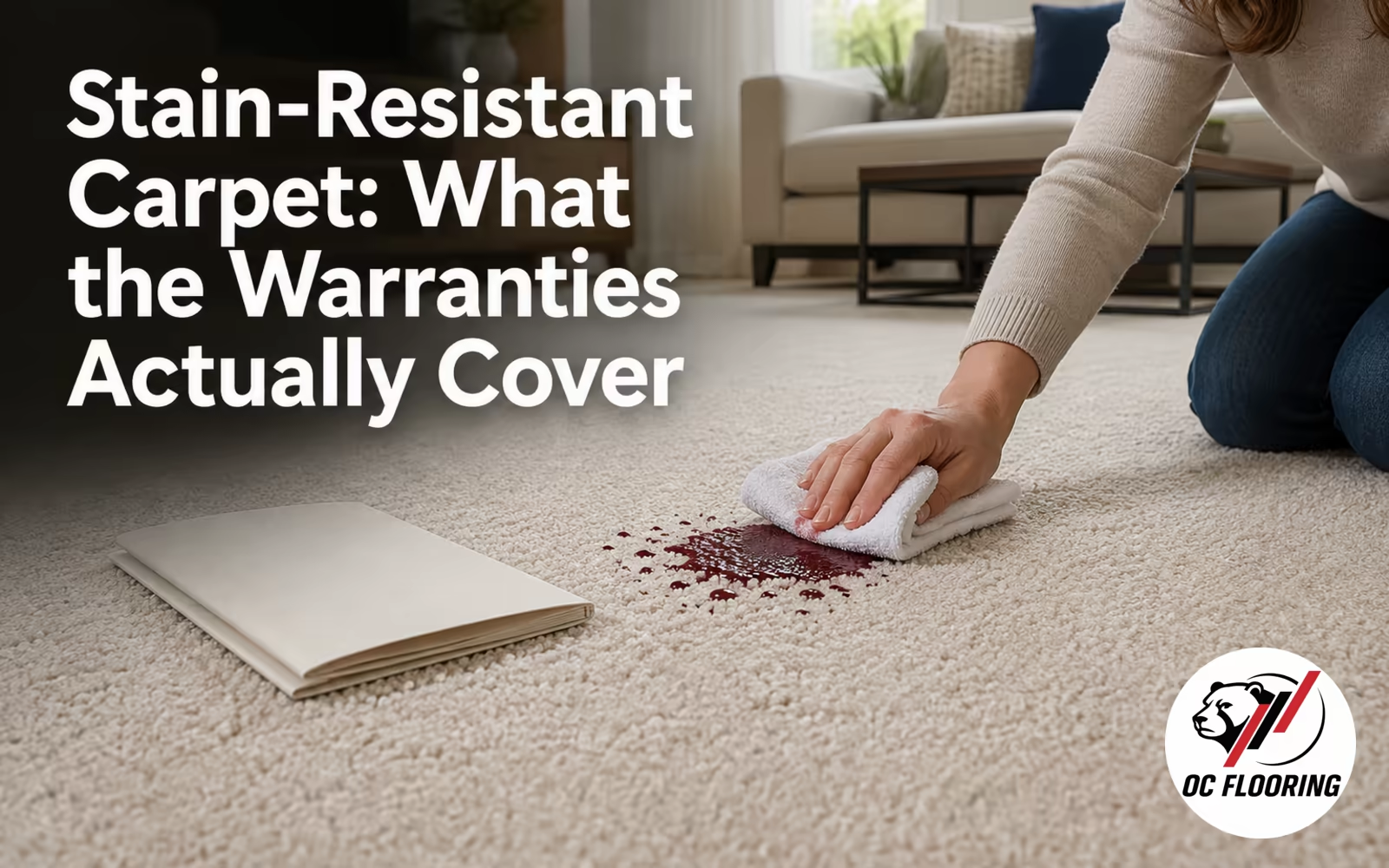



“Stain-resistant” covers two very different technologies: a topical treatment sprayed onto ordinary fiber at the mill, which fades with cleaning and traffic, and solution-dyed fiber, where color and stain resistance are built into the plastic itself and cannot wash off. The warranty behind the label is a list, not a promise — it names the substances it covers, quietly excludes oils, dyes and anything classed as wear, and requires cleaning records you have to keep. Buy the fiber, read the list, and put a moisture-barrier pad underneath — that is the order of operations that actually protects a Shoreline family's floor.
hide behind one label. Topical stain treatments ride on the fiber’s surface and thin out with every hot-water extraction; solution-dyed fiber is stain-resistant to its core, for the life of the carpet.
the professional cleaning interval most stain warranties quietly require — with receipts. Skip it, or clean with the wrong machine, and a valid claim can die on paperwork.
where installed carpet starts with us. The stain-resistant lines cost more per foot, and in the rooms where life actually happens, they are usually the cheapest insurance in the house.
“Stain-Resistant” Means Two Different Things
Walk any carpet aisle and nearly everything claims stain resistance, which should make you suspicious, and rightly so. The label describes two technologies that age in opposite directions. The first is topical: ordinary dyed fiber gets a stain-blocking treatment applied at the mill. It works on day one. It also lives on the surface of the fiber, which means foot traffic grinds it away in the lanes and every deep cleaning rinses a little more of it out — so it is weakest exactly where and when you need it most, in the busy zones of a carpet's middle age.
The second is inherent: the resistance is a property of the polymer itself. Polyester and triexta do not absorb water-based spills the way nylon does, and solution-dyed versions of any fiber take it further — more on that next. Inherent resistance cannot wear off, because it is not a coating; it is what the fiber is made of. When a salesperson says “stain-resistant,” the question that sorts the aisle is: is that a treatment or the polymer? The price difference between the two answers is real, and so is the difference in year six.
Solution-Dyed, Explained Properly
Conventional carpet is dyed the way fabric usually is: the fiber is made first, white, and the color is applied afterward, soaking into the outer layer. Solution-dyed fiber is colored before it exists — pigment is mixed into the molten polymer, and the fiber is extruded already colored, the way a batter baked with cocoa is chocolate all the way through rather than frosted. Cut a solution-dyed strand anywhere and the cross-section is the same color.
That construction buys you two things. First, nothing can un-dye it — sunlight through a south window, repeated enzyme cleanings, even a careful dab of diluted bleach on the worst spill leave the color intact, because there is no surface layer of dye to strip. Second, there is nowhere for a stain to bond that the pigment does not already occupy; spills sit on the fiber waiting to be blotted instead of moving in. It is the same reason outdoor carpet and marine upholstery are solution-dyed. For households mid-toddler or mid-dog, it is the difference between a carpet that survives cleaning and a carpet that fades in the exact spots you clean — the pale ghost patches every parent recognizes. Our pet carpet guide leans on the same technology for the same reason, and the brand guide covers who builds the serious solution-dyed lines.
What the Warranties Actually Cover
A stain warranty is not a force field; it is a list of substances with conditions attached. Read one — actually read it — and the shape is always the same. Covered: most food and beverage stains, the coffee-juice-wine family, usually soda and chocolate. Pet lines add pet urine, sometimes feces and vomit. That is genuinely useful coverage, and on a good line the manufacturer does stand behind it: a stain from a listed substance that will not come out with the prescribed cleaning process can get a section of carpet repaired or replaced.
Now the boundaries, because this is where homeowners get surprised. Nearly every stain warranty excludes oil-based and greasy substances — cooking oil, butter, salad dressing, lipstick, shoe polish. It excludes substances that dye: hair color, mustard, turmeric, children's paints, plant food. It excludes bleach and caustics as damage rather than staining (though solution-dyed fiber shrugs off what would ghost a conventional carpet). And the big one: it excludes anything classed as wear. The matted, darkened traffic lane that looks like a stain in year five is crushed, abraded fiber — a wear problem, covered by a different clause with its own exclusions, if at all. That distinction decides more claims than any other sentence in the document, and it is why fiber choice protects you where the warranty will not — a theme we develop in how long carpet lasts.
The Spill List, Honestly
| Substance | Typical warranty verdict | The reality on good fiber |
|---|---|---|
| Coffee, wine, juice | Covered | The headline coverage — blot fast, clean as prescribed, and solution-dyed fiber releases these well |
| Pet urine | Covered on pet lines | The stain cleans; the odor is a pad-and-subfloor problem no carpet warranty touches — barrier pad or bust |
| Cooking oil, grease, makeup | Excluded | Oil bonds to synthetic fiber; treat fast with a solvent-type spotter and temper expectations |
| Mustard, turmeric, hair dye | Excluded | These are dyes — they do to carpet what the mill does, minus the quality control |
| Bleach | Excluded as damage | Ghosts conventional carpet permanently; solution-dyed fiber is the one construction that largely shrugs it off |
| Mud, everyday dirt | Not a stain — maintenance | Vacuuming and scheduled cleaning; dirt held at the pile base is a wear accelerant, not a claim |
| Traffic-lane darkening | Excluded as wear | Crushed, abraded fiber reads as “stained” but no stain clause covers it — density and pile choice prevent it |
The Fine Print That Kills Claims
Assume every claim will be audited, because the successful ones effectively are. The recurring requirements: prompt treatment (some warranties specify how quickly a spill must be addressed), approved methods and products (the wrong spotter can void coverage on the spot it touched), professional hot-water extraction on a schedule — typically every 12 to 18 months — and receipts for all of it, plus your original proof of purchase. A folder in a kitchen drawer with the invoice and each cleaning receipt is unglamorous and it is exactly what a paid claim looks like. Also worth knowing: warranties follow the original purchaser and the original installation — coverage on carpet you inherited with the house is usually gone before you unpack.
What a stain warranty is genuinely good for
- Everyday food-and-beverage life with kids — the accidents that actually happen weekly
- Pet urine stains, on the lines that name them — a real, tested benefit
- Backing you up when a listed stain defeats the prescribed cleaning
- Signaling fiber quality — long stain terms ride on better polymer
- Keeping you honest about professional cleaning, which the carpet needed anyway
What it will never protect you from
- Oil, grease, dyes and bleach — the exclusions list is longer than the coverage list
- Traffic-lane matting and darkening — wear wearing a stain costume
- Odor in the pad and subfloor — that battle is won by the pad, before the first accident
- Skipped cleanings and missing receipts — paperwork loses more claims than chemistry
- The wrong carpet in the wrong room — no clause fixes plush in a mudroom hallway
Our Honest Spec, and Where Shoreline Comes In
Here is how we translate all of this at the kitchen table. In bedrooms and low-traffic rooms, inherent stain resistance is nice but not worth chasing — spills are rare there, and a comfortable plusher pile serves the room better. In family rooms, halls and anywhere under a dining chair or a dog, we spec solution-dyed fiber, a denser low-to-medium pile, and a moisture-barrier pad — the pad because urine and big spills go through carpet in seconds, and permanent odor lives in what is underneath. The warranty is the third line of defense, not the first; we treat it as a quality signal and keep the folder anyway.
Shoreline's housing stock argues the same way. Most of the city is 1950s and 60s ranches and split-levels — carpeted stairs between half-flights, family rooms a few steps down, hardworking halls — and those concentrated lanes are where topical treatments quit early and solution-dyed fiber earns its premium. The mobile showroom brings the serious stain-resistant lines and all three pad grades to your house, with a written price the same visit; the arithmetic behind that number is in how carpet is measured and what one room costs, and the local details are on our Shoreline carpet installation page.
Stain-Resistant Carpet: What Homeowners Ask Us
Is stain-resistant carpet actually worth it?
What is the difference between stain-resistant treatment and solution-dyed carpet?
What do carpet stain warranties actually cover?
What voids a carpet stain warranty?
Does stain-resistant carpet work against pet urine?
Can I use bleach or OxiClean on stain-resistant carpet?
Why does my stain-resistant carpet look stained in the hallway anyway?
What does stain-resistant carpet cost installed?
Read the Warranty Together, Before You Buy
We bring the serious stain-resistant lines to your house, show you which claims are fiber and which are marketing, and put the whole job — pad grade named — in writing the same visit. Free in-home estimates across Shoreline and all of King & Snohomish County.
Related reading: The best carpet for pet households · How long carpet really lasts · Low pile vs high pile, room by room · The best carpet brands · Carpet installation in Shoreline · Book a free estimate