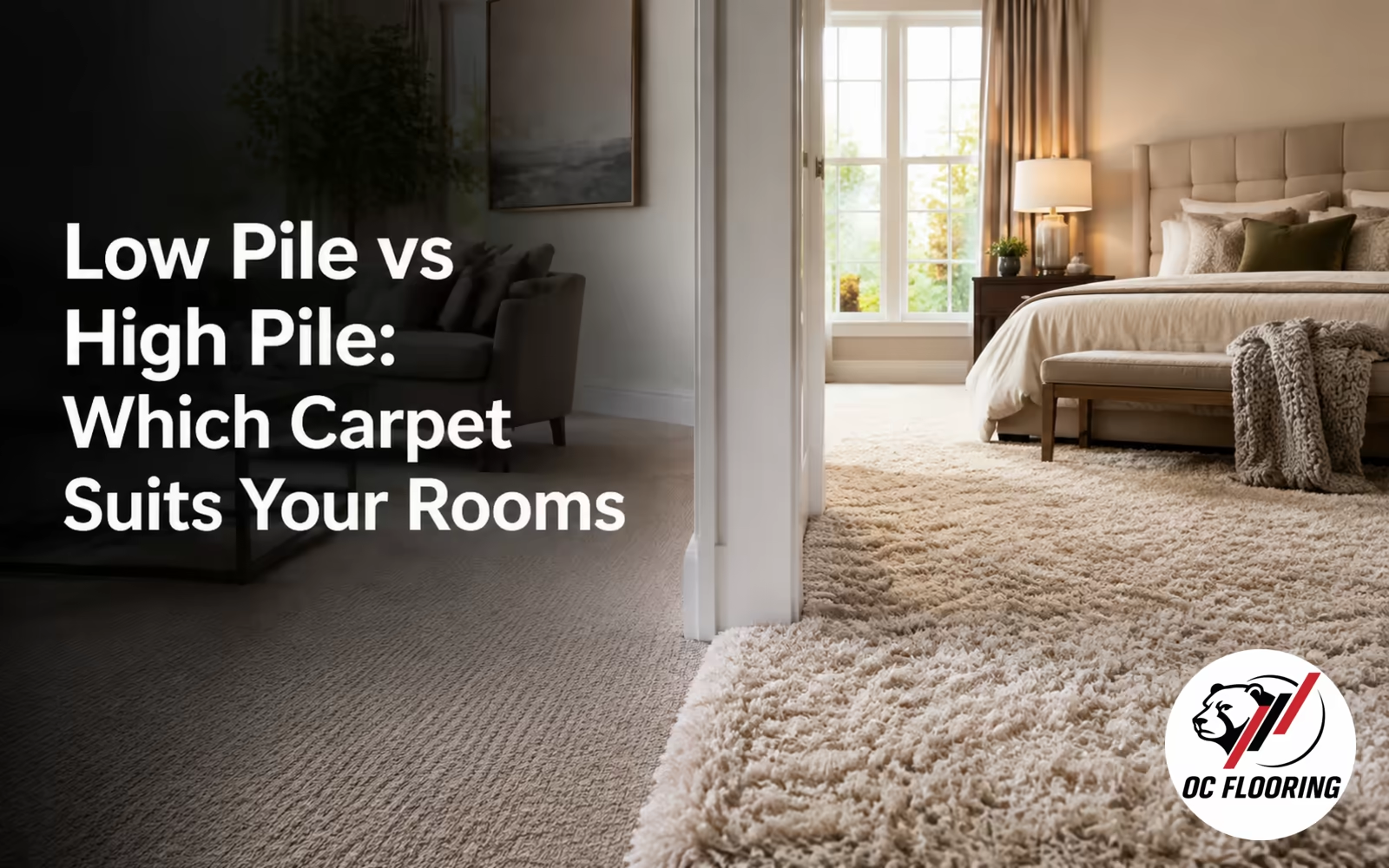



Low pile wins everywhere feet, paws and wheels actually work — hallways, stairs, family rooms, home offices — because short, dense fiber stands back up after traffic and lets a vacuum reach the grit at the bottom. High pile wins where comfort is the whole job: bedrooms, dens, anywhere you are more often barefoot than busy. The mistake is buying one carpet for the whole house based on how it feels in the store for four seconds. Most homes we carpet end up with both, split by room — and the split is the part worth getting right.
where installed carpet starts with us, low pile or high — material, pad and labor. Pile height moves the feel and the upkeep far more than it moves the price.
in the mobile showroom, across both pile families. Standing on a full-size piece in your own hallway settles the low-versus-high question faster than any article, including this one.
under every option we sell. Half of what people credit to “thick carpet” is actually the pad — a low-pile carpet on a proper pad feels more luxurious than plush on a cheap one.
What Pile Height Actually Means
Pile is the yarn you walk on, and pile height is how tall it stands — roughly, low pile sits under half an inch, high pile from three-quarters up, with a broad middle where most residential carpet honestly lives. But height never acts alone. Density — how tightly the tufts are packed — and twist — how hard each yarn is spun — decide whether that height survives traffic or lies down and stays down. A tall, loosely tufted carpet is a matting machine; a short, dense, hard-twisted one shrugs off years of feet. When you compare two samples, bend them backward: the more backing you see through the tufts, the sooner the traffic lanes will show.
One more distinction worth thirty seconds: cut pile versus loop. Loops (berber and its relatives) are naturally low and tough but snag on claws; cut pile is the default in homes and comes in every height. Everything below applies to cut pile unless we say otherwise — and if you share the house with a cat, our pet carpet guide explains why loops are off the menu entirely.
Where Low Pile Earns Its Keep
Traffic is the argument. Every footstep bends the fiber; short fiber bends less and recovers faster, which is why low pile is what you find in hotel corridors and why we spec it for hallways, stairs and family rooms at home. Grit is the other argument — the sand and dirt a household tracks in works down to the base of the pile and cuts fiber like sandpaper, and a vacuum actually reaches the bottom of a short pile. Chairs roll on it, doors clear it, robot vacuums do not beach themselves on it. On stairs low pile is close to non-negotiable: tall pile rounds over the stair nosing, wears at the fold, and hides the tread edge from descending feet, which is a safety point as much as a wear point.
The trade-off is plain: low pile is firmer underfoot and shows its construction. It reads tailored rather than sumptuous. A good pad restores much of the comfort — more on that below — but if your picture of carpet is sinking in, low pile will not paint it.
Where High Pile Is Worth It
Bedrooms are high pile's home field. The traffic is barefoot and light, the hours are gentle, and the whole point of carpet in a bedroom is the first step out of bed on a January morning. Tall pile also does real acoustic work — a plush bedroom is measurably quieter — and holds warmth over a cold-in-winter floor. Dens, studies, media rooms: anywhere the room's job is comfort, high pile does that job better than anything else we install.
The honest downsides: tall fiber mats where traffic concentrates, so a plush hallway will show a path within a couple of years no matter the brand. It holds pet hair and crumbs deeper than a vacuum's first pass, shows footprints and vacuum tracks (some people love that, some cannot stand it), and can crowd low-clearance doors. And matting is wear, not dirt — once the tufts crush and untwist in a lane, cleaning will not raise them. That is the failure mode described in how long carpet lasts, and pile height in the wrong room is its most common cause.
Pile Height, Room by Room
| Room | Our call | Why |
|---|---|---|
| Hallways & landings | Low pile | The most concentrated traffic in the house; short dense fiber keeps the lane from showing |
| Stairs | Low pile | Wraps the nosing cleanly, wears at the fold far slower, keeps tread edges visible underfoot |
| Family room | Low to medium | Real traffic plus furniture; a dense textured cut pile hides tracks and takes the beating |
| Bedrooms | Medium to high | Light barefoot traffic; comfort, warmth and quiet are the whole assignment |
| Home office | Low pile | Chair casters and pile height are enemies; short pile rolls clean and stays standing |
| Basement / rec room | Low to medium | Traffic plus the moisture conversation — see our basement guide before choosing anything |
| Condo, wall to wall | Low to medium, dense | Acoustic rules love carpet; doors, transitions and robot vacuums love it short |
Condo Life Likes It Short
Condos stack the deck toward low and medium pile. Entry doors and closet sliders are hung tight to the floor, and a tall carpet plus fresh pad can turn a door into a plough — shaving doors is a real line item tall pile quietly adds. Square footage is smaller, so the same few walking lanes concentrate all the traffic a house would spread around. HOA acoustic requirements are satisfied by carpet-plus-pad generally, not by height specifically — density and the right pad do the sound work. And in a small space, one carpet usually runs the whole home, which means it must handle the busiest lane in it: choose for the hallway, not the bedroom corner. A dense, low-profile textured cut pile over a quality pad is the condo answer nine times out of ten.
Vacuums, Robots and the Pile You Can Actually Maintain
A carpet you cannot vacuum properly is a carpet on a countdown, so check your equipment against your ambitions. Most uprights handle low and medium pile happily; deep plush wants a machine with an adjustable height setting and, often, the beater bar backed off before it scatters the tufts or stalls. Robot vacuums are low-pile specialists — most manage medium, and genuinely tall pile defeats the little fellow entirely. If the family cleaning plan is “the robot runs daily and a human appears on weekends,” buy pile the robot can climb. Grit at the pile base is what actually ages carpet, which makes vacuum reach a durability spec, not a chore detail — the longer version lives in carpet versus hardwood upkeep.
The Middle Ground We Sell Most
Between the extremes sits the carpet that ends up in most Northwest homes: a textured or twisted cut pile of medium height and honest density. The twist hides footprints and vacuum tracks, the height keeps some plushness, the density keeps the lanes from showing. Under it, the pad does the quiet heavy lifting — a mid-grade or better pad adds back the comfort a lower pile gives up, protects the fiber from crushing, and costs a fraction of moving up a carpet line. We bring all three pad grades with the samples so you can feel the combinations, not imagine them.
And the split-by-room approach is not an upsell — it is how the math works out best. Low pile on the stairs and hall where the wear is, something taller behind the bedroom doors where the comfort is, one coherent color family so the eye reads it as a plan. Priced from the same roll logic explained in how carpet is measured, it usually costs no more than flooding the house with one compromise carpet — details and numbers on our Seattle carpet installation page.
Choose low pile when
- The room is a hallway, staircase, family room or office — anywhere traffic concentrates
- Pets with claws live there — short cut pile, nothing looped
- A robot vacuum is part of the cleaning plan
- Doors, closet sliders and transitions run tight to the floor
- You want the tailored look and the longest wear from the same budget
Choose high pile when
- The room is a bedroom, den or media room with light, mostly barefoot traffic
- Warmth, quiet and softness are the point of the purchase
- You are ready to vacuum with a height-adjustable machine, slowly
- Footprints and vacuum tracks read as cozy to you, not as mess
- The pad underneath is at least mid-grade — plush on cheap pad flattens fastest of all
Low Pile vs High Pile: What Homeowners Ask Us
What counts as low pile and what counts as high pile?
Which is more durable, low pile or high pile carpet?
Is high pile carpet bad for pets?
What pile height is best for stairs?
Will a robot vacuum work on high pile carpet?
Does high pile carpet make a room warmer and quieter?
Can I mix pile heights in the same house?
Does pile height change the installed price?
Stand on Both Before You Decide
The mobile showroom brings low, medium and plush samples — full-size pieces, all three pad grades — to your own hallway and bedroom light. We measure every room and stair and leave a written price the same visit. Free in-home estimates across King & Snohomish County.
Related reading: The best carpet for stairs · The best carpet for pet households · How long carpet really lasts · How to measure a room for carpet · What carpet installation costs in Seattle · Carpet installation in Seattle · Book a free estimate