



A heated bathroom floor is an electric mat or cable set into the tile assembly, and in most Marysville bathrooms it adds a modest slice to the remodel: the heating materials, about a day of schedule, and an electrician's visit for the dedicated circuit and thermostat. The tile job itself — $14–$26 per square foot installed with us — is still most of the budget. The catch is timing: floor heat goes in under the tile, so the only affordable moment to add it is while the floor is already open. Skip it during the remodel and adding it later means doing the floor twice.
installed tile cost with us, labor from $11/sq ft. The heating layer rides inside that same assembly — one mobilization, one floor, done once.
roughly what floor heat adds to a bathroom tile schedule. The mat or cable goes down fast; the self-leveling pour and the electrician’s hookup are the added time.
our warranty on tile work. We also meter the heating wire before, during, and after setting tile, so a damaged circuit is caught while it is still fixable.
What You Are Actually Buying
Strip away the brochure language and a heated bathroom floor is simple: a resistive electric wire, spread evenly under the tile, driven by its own thermostat with a sensor in the floor. Tile is the perfect partner for it — the same density that makes tile feel cold in January makes it hold and radiate warmth beautifully once heated. There is no furnace involved, no ductwork, no maintenance schedule. The system either works quietly for decades or is damaged during installation and never works right — which is why who installs it matters more than which brand is on the box.
One honest clarification before the details: this article is about electric radiant, the kind that makes sense in a single bathroom. Hydronic radiant — hot water tubing fed by a boiler or heat pump — is a whole-house heating strategy, wonderful in new construction and rarely economical to retrofit into one bathroom. If a quote for a hall bath includes a boiler, someone is solving a different problem than the one you have.
Mat vs Cable: The Real Difference
Every electric system is the same wire at heart; what you are choosing is how it gets spread across your floor. That choice moves labor, flexibility, and a little bit of cost.
Electric Floor Heat: The Three Ways It Arrives
| System | Best for | The honest trade-off |
|---|---|---|
| Heating mat | Simple, rectangular rooms | Wire pre-spaced on a mesh roll — fastest to install and hardest to get wrong; less flexible around tubs, toilets and angled walls |
| Loose cable in an uncoupling membrane | Bathrooms with real geometry | Cable snapped into a studded membrane, routed wherever you want heat; more layout labor, but heat exactly where feet go and none wasted under the vanity |
| Hydronic (water) radiant | Whole-house projects, new builds | Lovely warmth and cheap to run at scale, but boiler, manifold and tubing make it the wrong tool for a single bathroom retrofit |
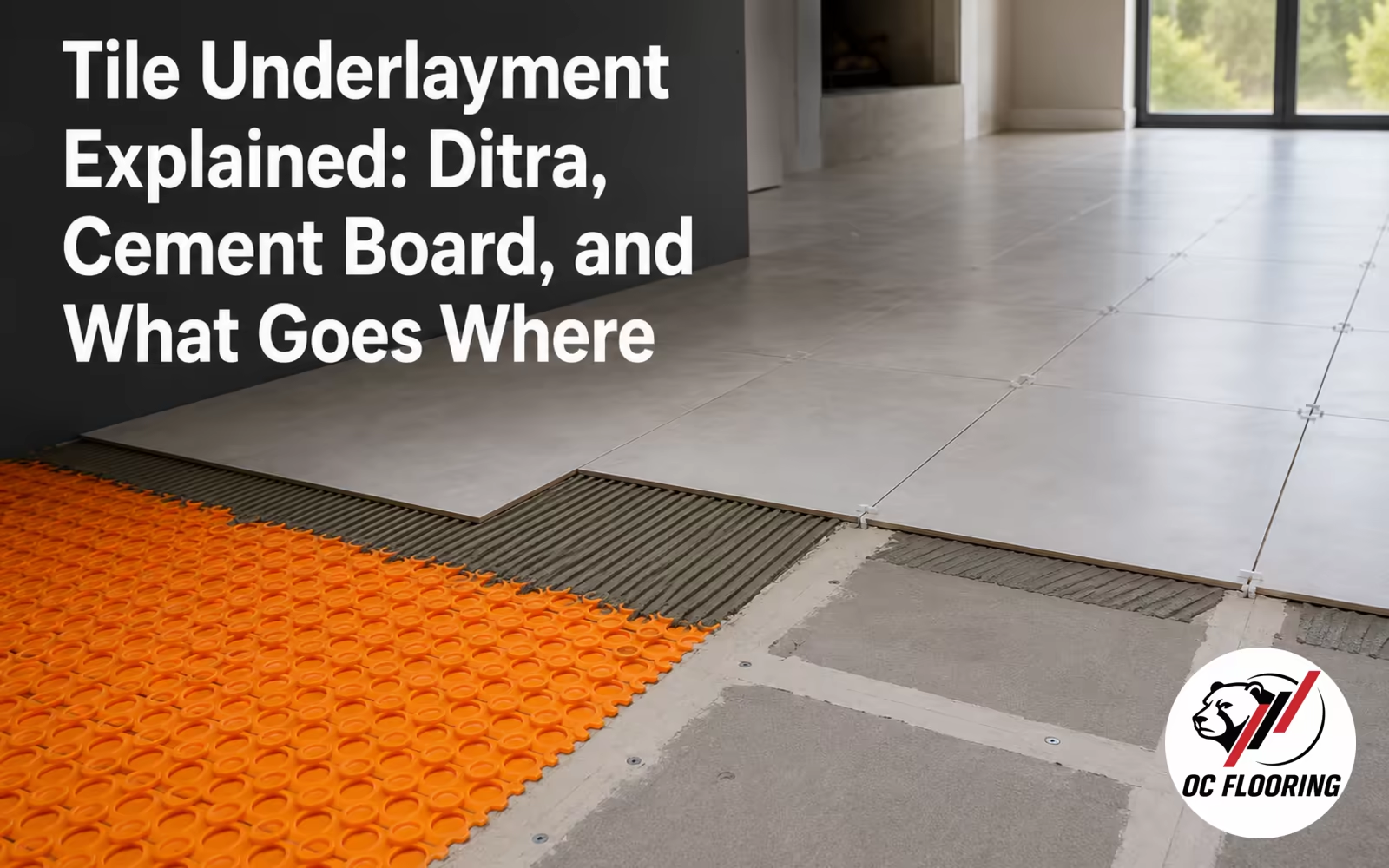
Between the two electric options, our default is honest: a mat where the room is a rectangle, cable in a membrane where it is not. Marysville bathrooms in the 1990s and 2000s subdivisions off 88th and near Getchell tend to be straightforward rectangles — mat territory. The older houses downtown and out toward the Pilchuck with clipped corners, angled tub decks, or a floor plan that grew over the decades usually justify the cable. The membrane version has a second advantage: the same layer doubles as an uncoupling membrane, the crack-isolation workhorse we cover in our underlayment guide.
Where the Money Goes in the Quote
A heated-floor line on a tile quote is really four smaller lines, and it helps to see them separately. The heating materials — mat or cable, membrane if used, thermostat and floor sensor — are typically several hundred dollars for a normal bathroom, rising with square footage. The added tile labor is the careful hour of layout and metering plus, for cable systems, a self-leveling pour to encase the wire before tile goes on. The electrician runs a dedicated circuit with GFCI protection and wires the thermostat — a separate trade's visit, priced by your panel's location and capacity, not by us. And the tile job itself stays what it always was: $14–$26 per square foot installed, with the drivers we itemize in our bathroom tile cost guide and the per-square-foot breakdown.
One discipline item separates a professional heated-floor install from a gamble: the ohm test. We meter the wire's resistance when the box is opened, after the mat is placed, and again after tile is set, and the readings go in the job file. A wire nicked by a trowel and caught before grout is a repairable moment; the same nick discovered when the thermostat reads an open circuit in November is a floor coming back up. The meter readings are cheap insurance, the same philosophy as the flood test in our shower waterproofing guide: prove the hidden layer works before it is buried.
When heated floors earn their money
- A primary bathroom used every morning, all winter
- Tile over a cold crawlspace or concrete — most of Marysville
- A remodel that already has the floor open
- Cable routed only where bare feet actually go
- A programmable thermostat that heats for the morning hour, not all day
- Anyone who has met a Snohomish County January floor barefoot
When we tell people to skip it
- A guest bath used a handful of mornings a year
- A budget that would trade waterproofing or prep to afford it
- Expecting the heat to pay for itself at resale — it will not
- Planning it as the room’s primary heat source
- A floor with rot or structural work that should get the money first
- Retrofitting under an existing tile floor you otherwise like
The Marysville Winter Payback Argument
Let us be straight about the finances: a heated bathroom floor does not pay you back in dollars. Its operating cost is real — modest, because a small bathroom's mat draws about what a hair dryer does and a programmable thermostat only runs it a few hours a day, but real. And appraisers do not add a line for it. What you are buying is the difference between how a tile floor feels at 6 a.m. in a Marysville January — where the outside air has been sitting in the low 40s and raining sideways since October — and how the same floor feels holding a gentle warmth it has had since before your alarm went off.
Tile feels cold because it is conductive: it pulls heat out of your foot faster than carpet or wood do, even at the same room temperature. Floor heat does not just cancel that; it reverses it. In our experience the households that add it in one bathroom add it in the next remodel too, without being sold on it — which is the most honest endorsement a product gets. It also pairs naturally with the kind of quiet, warm-neutral porcelain that survives a decade of taste, the case we make in bathroom floor tile that still looks right in ten years.
Install Reality: How It Actually Goes In
The sequence matters, because the heat is a layer in the middle of the assembly, not an appliance added at the end. The substrate gets prepped and flattened first — heat does not fix a bad floor, and a cracked tile over a heating wire is a worse problem than a cracked tile alone. The electrician roughs in the circuit. The mat or membrane and cable go down, the floor sensor is placed, and everything is metered. Cable systems get a self-leveling pour; then tile is set and grouted exactly as it would be on any quality job, and the electrician returns to connect the thermostat once the assembly has cured. From your side it reads as one extra day inside a normal bathroom tile schedule.
The one thing the sequence cannot do is run in reverse. There is no practical way to slide heat under a finished tile floor; adding it later means demolition, which is why the right time to decide is while your remodel is on paper. If a heated floor is on your maybe-list, have the conversation at the estimate — the full scope of what we install, heated floors included, is on the Marysville tile installation page.
Heated Bathroom Floor Cost: What Homeowners Ask Us
How much does a heated bathroom floor cost?
Do heated floors need an electrician?
Which is better, a heating mat or loose cable?
How much does it cost to run a heated bathroom floor?
Can you add floor heat under existing tile?
Does floor heat work under any tile?
Will a heated floor keep the whole bathroom warm?
Is a heated bathroom floor worth it in Marysville?
Warm Floors Before the Cold Mornings Land
If a bathroom remodel is on your list, this is the moment to decide on heat — it costs little while the floor is open and a whole floor later. We will price it both ways, coordinate the electrician, and put the full scope in writing. Free in-home estimates across King & Snohomish County.
Related reading: Bathroom tile cost, itemized · Tile underlayment explained · Shower waterproofing, layer by layer · Floor tile that ages well · Tile installation in Marysville · Book a free estimate