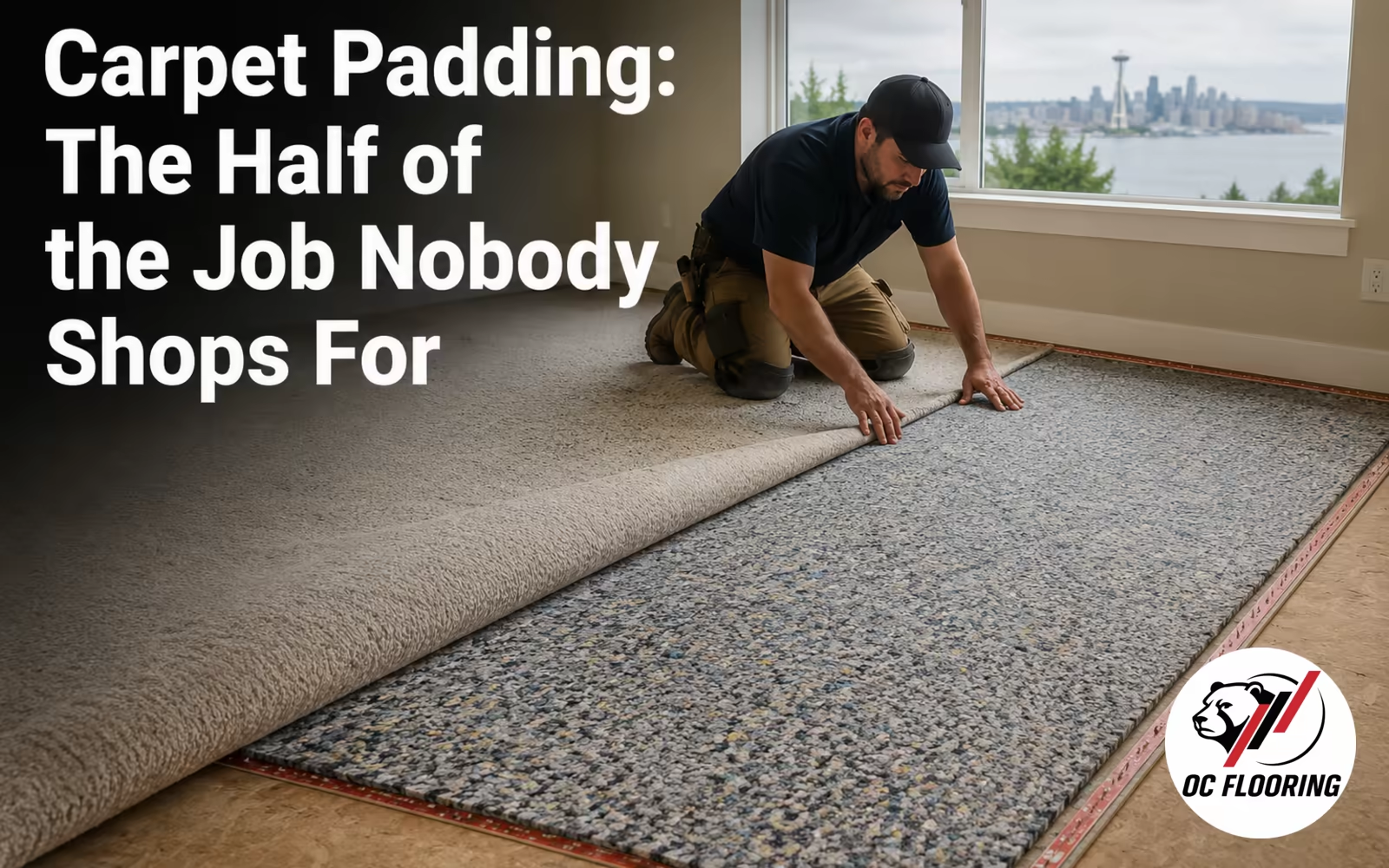



For most rooms the right carpet pad is about 7/16 of an inch thick at a healthy density — and of those two numbers, density is the one that decides how the floor feels in year eight. Thicker is not better: past roughly half an inch the carpet flexes too much, seams work loose, and some carpet warranties quietly disqualify the install. The pad is the half of the job nobody shops for, which is exactly why we carry three grades, bring all three to the estimate, and make you stand on them before you pick. Four seconds on each and the decision makes itself.
in the mobile showroom on every estimate. The differences are obvious underfoot in seconds — which is longer than most people have ever spent thinking about pad, and it shows in how carpets age.
the residential sweet spot for pad thickness under most cut-pile carpet. Beyond half an inch the floor gets bouncier, not better — and seams, stretch and warranties all start to complain.
how long a spill or an accident takes to pass through carpet and reach the pad. What that pad does next — soak it up, or stop it — is the whole moisture-barrier conversation.
The Half of the Floor You Never See
Every quote we write has a line for pad, and it is the line people skim. Understandable — you will never see it again after install morning — but the pad is doing a job every minute the carpet is on the floor. It absorbs the impact of every footstep so the carpet backing does not have to. It insulates the room and quiets it. It is the reason carpet feels like carpet instead of fabric glued to plywood. And it is the difference between a carpet that looks tired at year four and the same carpet looking fine at year ten: without enough support underneath, the backing flexes on every step, the tufts crush in the lanes, and the floor ages at double speed. That failure mode — a good carpet murdered by a cheap pad — is one of the most common things we tear out, and how long carpet lasts is largely a story about what was under it.
Thickness vs Density: Buy the Number You Cannot Feel in the Store
Pad has two specs. Thickness is the one everyone asks about, because it is the one hands can measure. Density — how much material is packed into each cubic foot, quoted in pounds — is the one that matters, because it decides whether the pad still pushes back after a hundred thousand footsteps. A thick, low-density pad feels wonderful in a showroom squeeze and collapses in the hallway within a couple of years, taking the carpet's support with it. A slightly thinner, denser pad feels firmer on day one and feels exactly the same on day three thousand. When only one spec fits in your head, keep density.
And resist the instinct that more inches equal more luxury. Past about half an inch of cushion, the carpet above starts to flex like a trampoline skin: seams work themselves visible, the power-stretch loosens sooner (ripples are a stretching problem, as our restretching guide explains, but over-thick pad helps cause them), and stair installations get outright spongy. Several carpet manufacturers cap the pad thickness their warranties accept — usually right around that half-inch line, thinner still for berber and other looped styles, which want a firm, dense, low-profile pad so the loops stay supported. The right answer is almost never the thickest pad on the rack; it is the densest pad at the correct thickness for your carpet.
The Three Grades We Bring to Every Estimate
| Grade | What it is | Where it belongs |
|---|---|---|
| Essential | A solid, code-honest rebond pad — the grade most “installed free” offers quietly assume | Guest rooms, rentals, rooms on a strict budget or a short clock before a sale |
| Mid-grade | Noticeably denser rebond; the feel most people expect when they imagine new carpet | Bedrooms, family rooms, most of most houses — the default we recommend |
| Premium | High-density cushion that keeps traffic lanes supported for the life of the carpet | Halls, stairs, main living spaces — and anywhere plush comfort is the point |
| Moisture-barrier option | A sealed top layer over a dense pad, so liquid stays up where cleaning can reach it | Pet households, kids’ rooms, dining rooms, basements — the cheapest odor insurance there is |
Stand on All Three — the Four-Second Test
Descriptions only go so far, which is why the pad grades ride along in the mobile showroom with the twenty-plus carpet samples. We lay them on your floor, put your chosen carpet over each, and you stand on them. The essential grade feels fine until you feel the mid-grade; the premium explains itself. What you are feeling is density doing its work, and the same difference your feet detect in four seconds is the difference your carpet's backing experiences on every step for a decade. The upgrade from grade to grade costs a fraction of what stepping up a carpet line costs — pad is the cheapest place in the whole quote to buy longevity, a point our carpet cost guide makes with numbers.
Moisture-Barrier Pads, Explained Without the Marketing
An ordinary pad is an open sponge. A spilled glass, a puppy's mistake, a toddler's science experiment — liquid is through the carpet in seconds and into that sponge, which holds it against the subfloor where no towel, rented machine or professional wand can reach. That is why a cleaned carpet can smell fine for a week and then bloom again on a humid day: the smell was never in the carpet. A moisture-barrier pad adds a sealed top layer, so the accident pools on top of the pad, inside the carpet, where cleaning actually works.
We treat barrier pad as non-negotiable under pet-household carpet, and strongly recommend it for young families, dining rooms and finished basements — anywhere the first bad spill is a matter of when. Two honest notes: it protects the floor system, not the carpet's surface, so pair it with a sensible fiber (our stain-resistance guide sorts that aisle), and it is not a waterproofing system — a basement with a moisture problem needs that solved first, as our basement carpet guide lays out.
Bothell Floors, Specifically
Bothell's housing runs the full spread — 1960s–80s split-levels off Main Street and Maywood, newer townhomes stacked three stories tall around Canyon Park and North Creek — and both types are stair-heavy. Stairs are where pad choices show up first: a dense, firm pad keeps treads crisp and safe underfoot, while a soft, thick one rounds the nosing and wears the fold, which is why our stairs guide and every stair quote we write lean firm and dense. Split-level lower floors get the moisture conversation before the color conversation, and townhome party walls make the acoustic side of a good pad a neighborly upgrade too. We measure all of it in person and put the pad grade, by name, in the written price the same visit — the full local rundown is on our Bothell carpet installation page.
Pad money well spent
- One grade up from whatever the quote “assumes” — ask for the grade by name
- Moisture barrier anywhere pets, kids or wine glasses operate
- Dense and firm under stairs and hallways — the lanes that decide how the house wears
- Premium under plush bedroom carpet — softness that lasts comes from underneath
- New pad under new carpet, every time — it is a fraction of the job’s cost
Pad mistakes we get called to undo
- The thickest pad on the rack under a looped berber — spongy, seam-popping, warranty-voiding
- Reusing crushed old pad because “it looks fine” — it never is, and the new carpet ages like the old one
- Bargain pad under a premium carpet — priorities exactly backwards
- Ordinary sponge pad in the dog’s favorite room — the odor lease is signed at install
- Judging pad by the showroom squeeze — thickness flatters the hand; density serves the floor
Carpet Padding: What Homeowners Ask Us
What thickness should carpet padding be?
Is thicker carpet padding better?
What density should carpet padding have?
Can I reuse my existing carpet pad under new carpet?
What is a moisture-barrier pad and do I need one?
Does carpet padding affect the carpet warranty?
Is padding included in your installed carpet price?
What padding is best for stairs?
Choose Your Pad With Your Feet On It
The mobile showroom brings twenty-plus carpet samples and all three pad grades to your Bothell home. Stand on every combination, get every room and stair measured, and keep the written price we leave the same visit. Free in-home estimates across King & Snohomish County.
Related reading: The best carpet for pet households · Stain-resistant carpet and its warranties · How long carpet really lasts · The best carpet for stairs · Carpet installation in Bothell · Book a free estimate